7 min read
Marrying a U.S. citizen can open a path to a green card, but marriage alone does not establish eligibility. Your entry, immigration history and circumstances during the process shape your options. For the stages of a marriage-based case, see our guide to the marriage green card.
Understanding what shapes this process helps you plan your next step. Your current status, how you entered the U.S. and whether your marriage is genuine matter, alongside admissibility and the other requirements for your case.
If you’re exploring your options and need guidance, our family immigration lawyers can support you along the way. A common question is what happens if the relationship ends; we cover that in our guide on divorce and your green card.
What does marrying a U.S. citizen mean for your immigration future?

When you marry a U.S. citizen, you may qualify to pursue a marriage-based green card. The process involves several administrative steps; approval depends on the applicable requirements and your individual circumstances.
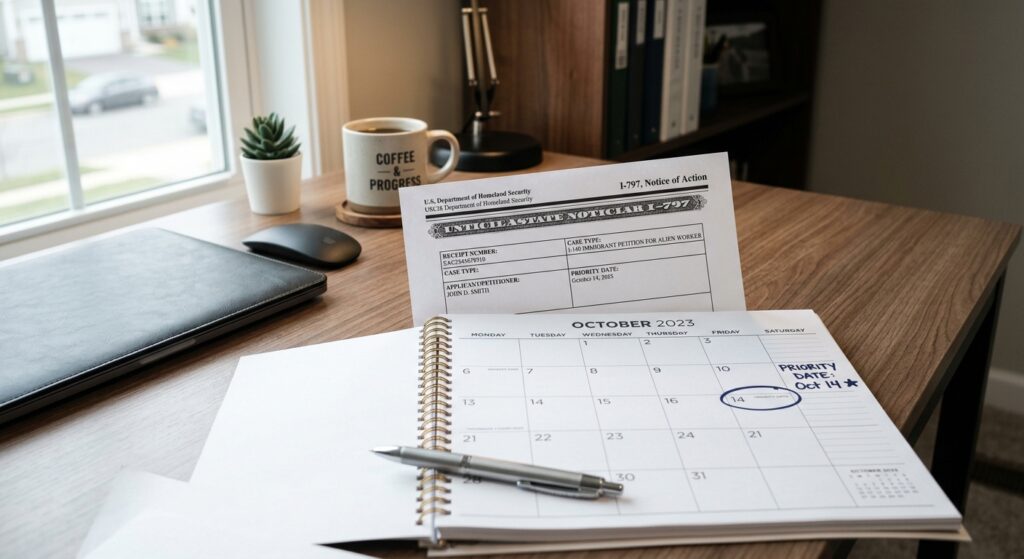
In the ordinary marriage-based process, your spouse files a family petition, Form I-130, Petition for Alien Relative, with USCIS. It asks the government to recognize the qualifying relationship as the basis for an immigration benefit. Filing or approving the petition does not itself grant lawful status or permanent residence.
The two main paths are adjustment of status and consular processing. Your entry, immigration history, current circumstances and eligibility requirements help determine which route is available and appropriate.
The legitimacy of your marriage is also key. Officers look for a real relationship, not a marriage entered into to get immigration benefits, because marriage fraud carries serious consequences.
How do you know if you can adjust status or need consular processing?
Once the marriage is recognized, the route to your green card splits depending on your situation in the U.S. Understanding the difference helps you avoid mistakes, because each path has its own requirements and timelines that directly affect your eligibility.
Adjustment of status may be available if you are physically in the U.S. and were inspected and admitted or inspected and paroled, subject to limited exceptions. Parole is different from admission. You must also meet the other adjustment eligibility requirements, including admissibility or an available remedy, and merit favorable discretion.
As the spouse of a U.S. citizen, you are an immediate relative. If eligible, you can usually file I-130 and I-485 together. Certain bars for overstaying, failing to maintain status or unauthorized employment do not apply to immediate relatives; that exemption does not remove all adjustment bars or grounds of inadmissibility.
Under USCIS guidance dated May 21, 2026, when consular processing is available and adjustment is discretionary, officers weigh positive and negative factors in the individual case. Dual-intent status is not itself inconsistent with adjustment, but does not ensure approval. Some other adjustment categories are nondiscretionary. This guidance does not impose a blanket ban or mean you should leave the country.
With adjustment, you apply without leaving the U.S. That avoids triggering a departure-based unlawful-presence bar through that particular departure; it does not eliminate other possible grounds of inadmissibility.
On the other hand, consular processing is generally the path if you entered the U.S. without inspection (EWI) or if you live outside the country. After the family petition is approved, you finish your case at a U.S. embassy or consulate, usually in your home country. That trip carries risks if you have a complicated immigration history. Some people who entered without inspection may have an exception that lets them adjust inside the U.S. (for example, section 245(i) or VAWA), so have your case reviewed before you decide.
For your specific case, our adjustment of status lawyers can help you find the most viable option. Here is a comparison table of the differences that matter most:
| Criteria | Adjustment of status (inside the U.S.) | Consular processing (outside the U.S.) |
|---|---|---|
| Where the applicant is | Inside the United States | Outside the United States |
| Entry requirement | Inspected and admitted or paroled, with limited exceptions | Prior entry history varies; if in the U.S., the visa interview is abroad |
| Main application form | I-485 (Application to Register Permanent Residence or Adjust Status) | DS-260 (Immigrant Visa Application) |
| Risk of leaving | No departure needed for adjustment; other grounds may still apply | Departure can trigger a bar depending on unlawful presence and other facts |
| Interview | Usually at a USCIS office in the U.S. | At the U.S. embassy or consulate abroad |
Choosing the appropriate path can help avoid unnecessary delays or a denial caused by an ineligible route. The key is to assess your immigration situation accurately before filing or making travel plans.

What documents and evidence will immigration ask for your marriage?
To prove that your marriage to a U.S. citizen is real and not only a way to get immigration benefits, immigration authorities ask for a set of documents and evidence. The strength of this evidence is the backbone of your case, whether you choose adjustment of status or consular processing.
You need evidence that you entered a genuine marriage. The required documents depend on the form and stage; joint-life evidence can include the examples below. You do not need every example, and a temporary separation does not by itself establish marriage fraud.
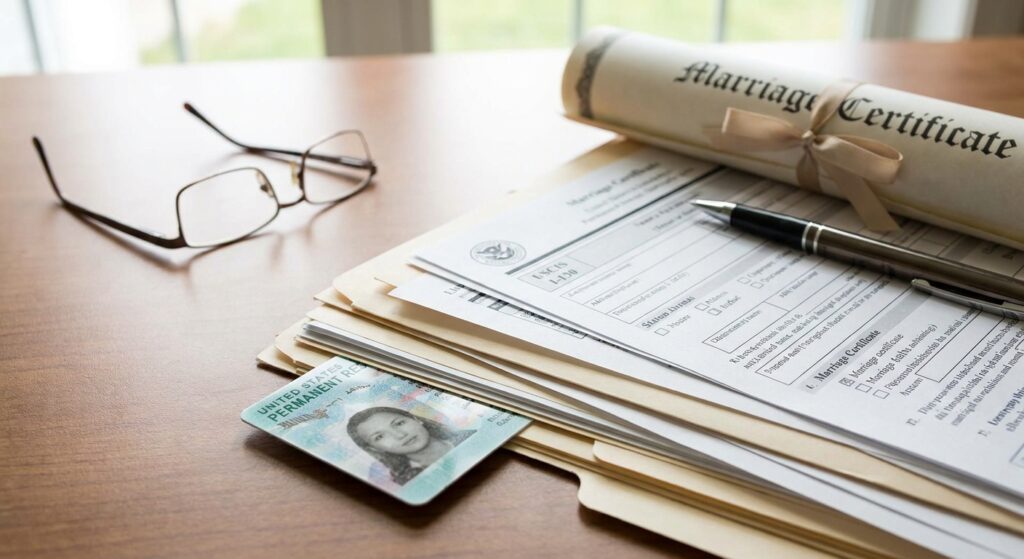
- Marriage certificate: Proof of a legally valid marriage where it took place. Include evidence that either spouse’s prior marriages legally ended, if applicable.
- Identity and citizenship documents: Your civil documents as required for the relevant stage, and accepted evidence of your spouse’s U.S. citizenship, such as a qualifying birth certificate, U.S. passport or naturalization certificate.
- Proof of living together: Leases or mortgages in both names, shared utility bills (electricity, water, internet), or official mail sent to the same address.
- Shared finances: Joint bank account statements, credit cards in both names, insurance policies naming each other as beneficiary, or mutual wills.
- Photos and statements: Photos of the two of you over time, with friends and family, that show your life together. You can also include sworn statements (affidavits) from people who can vouch for your relationship.
- Children’s documents: If you have children together, their birth certificates are strong proof of the relationship.
- Affidavit of Support (Form I-864): Usually required from your petitioning spouse unless an exemption applies. The sponsor must meet age, U.S. domicile and financial requirements, using sufficient income and, when needed, qualifying assets. By signing I-864, the sponsor agrees to a support obligation that becomes enforceable when you become a lawful permanent resident based on that affidavit; it does not by itself resolve every public-charge or other admissibility issue.
Gathering the required evidence ahead of time helps you file a complete case. Missing or insufficient evidence may prompt a Request for Evidence (RFE), but a complete file does not guarantee approval.
What if you have a complicated immigration history or a violation?
Your situation when marrying a U.S. citizen can get complicated if you have entries without inspection, long overstays, certain criminal records, or cases with USCIS or the immigration court. Those facts require individual review: some can create barriers, and not every barrier has an available immigration waiver.
A waiver is a formal request for relief from a specific ground of inadmissibility that would otherwise prevent a benefit. It is available only when the law permits it, has its own eligibility requirements and generally requires favorable discretion.
For an unlawful-presence waiver, you generally must show extreme hardship to a U.S. citizen or permanent resident spouse or parent if admission is refused. Available waivers and their requirements depend on the ground involved. The I-601 waiver covers several grounds, but not all.
That’s why, if your history includes undocumented entries, crimes, or periods of unlawful presence, trying this on your own is risky. Accurate information and a legal strategy tailored to your case help you avoid serious mistakes. You can also review the crimes that can make you inadmissible.
For cases like these, talking with experienced green card attorneys is the best way to understand your options and prepare a waiver if one applies.
How long does the whole process take and what are the stages?
How long a marriage green card takes varies a lot. It depends on the USCIS workload, the office handling your case, and whether you go through adjustment of status or consular processing. For more detail on each stage and 2026 timelines, see our guide to the marriage green card.
The times USCIS publishes are only estimates and can change without notice, so check the official USCIS processing times often. In general, the process has these key stages:
- I-130 petition: Your U.S. citizen spouse files Form I-130. Timing depends on the case and USCIS workload; check current information for your form and office.
- Petition approval: Once the I-130 is approved, USCIS sends you a notice. This is an important step that confirms your relationship qualifies for immigration purposes. Learn more in I-130 approved: what’s next.
- Green card application: If eligible to adjust, you file I-485, potentially together with I-130 because a visa is immediately available to an immediate relative. In consular processing, NVC handles the next steps after petition approval. The time needed varies by case and route.
- Interview: If USCIS requires an adjustment interview, both spouses usually attend; the officer reviews documents and the relationship. In consular processing, the immigrant spouse attends the embassy or consulate interview.
- Final decision: See what happens after your immigration interview. Approved adjustment grants permanent residence. Abroad, an approved immigrant visa allows travel to request admission; CBP decides admission, and permanent residence begins upon admission as an immigrant.
Timelines can stretch, so being ready for each stage with every required document helps you avoid extra delays. You can follow your case with our guide on how to check your USCIS case status.
What is a conditional green card and how do you remove the conditions?
Marriage-based permanent residence can be conditional. A conditional resident is already a lawful permanent resident, with additional requirements to remove the conditions. If the relationship ends, see our guide on divorce and your green card.
Why can your first green card be conditional?
Residence is conditional if the marriage is less than two years old when you acquire permanent resident status: the date adjustment is approved, or the date you are admitted as an immigrant after consular processing. The date the physical card arrives does not determine this rule.
It means you get a green card valid for two years instead of the usual ten. The goal is to confirm that the marriage is real and not a front to get a green card.
How do you remove the conditions on your green card?
For the usual joint filing, both spouses submit Form I-751, Petition to Remove Conditions on Residence during the 90 days immediately before conditional residence expires. Individual and waiver filings have different rules, described below; the joint filing window does not apply universally to them.
Missing the required filing can cause loss of conditional resident status and removal proceedings. USCIS may excuse a late joint filing if you establish good cause and extenuating circumstances. Explain the delay and submit supporting evidence; do not assume a late filing will be accepted.
Submit evidence of a good-faith marriage where the filing basis requires it. For a joint filing, include updated evidence of the relationship, such as home, financial and family documents. For an individual or waiver filing, provide the evidence required for that basis; a current marriage or continued cohabitation is not required for every basis.

Are there exceptions for removing the conditions?
If your petitioning spouse died after you became a conditional resident, you can file individually, with proof of death and a good-faith marriage; this is not a waiver. A good-faith marriage that ended in a final divorce or annulment can support a waiver. Battery or extreme cruelty, or qualifying extreme hardship, can also provide separate waiver grounds.
Each basis has its own requirements and evidence; abuse does not require a final divorce. Under the USCIS individual-filing rules and I-751 instructions, eligible individual or waiver filings can be submitted outside the ordinary joint filing window. Review the timing and requirements for your specific basis.
Our family immigration lawyers can review the applicable filing basis, help organize the evidence and work with you on the relevant deadlines.
To discuss your options, contact YSL Immigration Lawyers, founded by attorney Yohana Saucedo, with offices in Austin and Laredo, Texas. We can review your circumstances and help you plan the steps available in your case.
Frequently asked questions about marrying a U.S. citizen
Can I marry a U.S. citizen if I’m undocumented?
Marrying a U.S. citizen can open a path even if you are undocumented, but entry and all other eligibility requirements matter. If inspected and admitted or paroled, you may be eligible to adjust despite an overstay as an immediate relative, subject to other bars, admissibility and favorable discretion.
After entry without inspection, consular processing is generally the route, although exceptions such as 245(i) or VAWA may permit adjustment if you meet their requirements. Departure can trigger an unlawful-presence bar. An I-601A provisional waiver may be available for that specific ground, but not every case needs or qualifies for it, and it does not waive other grounds or guarantee a visa. Have the case reviewed before leaving.
What happens if I get divorced before I get my permanent green card?
It depends on the stage. Divorce before acquiring permanent residence generally ends the marriage-based route, unless another option applies, such as VAWA if there was abuse and you qualify. If you already have conditional residence, you may request an I-751 waiver based on a good-faith marriage and final divorce. Eligibility and evidence still matter; approval is not automatic.
Does my U.S. citizen spouse take on any legal or financial responsibility by sponsoring me?
Yes. By signing I-864, your spouse agrees to a financial support obligation that becomes enforceable when you become a lawful permanent resident based on that affidavit. It generally continues until you become a U.S. citizen, can be credited with 40 qualifying work quarters, die, or leave the U.S. after ceasing to be a lawful permanent resident; the sponsor’s death also ends it.
Forty quarters commonly correspond to ten years, but qualifying credits may include a spouse’s or parent’s work under the applicable rules. Divorce does not end the obligation. A trip abroad alone does not end it.
Can I get a work permit while I wait for my marriage green card?
If you are in the U.S. and eligible for adjustment, you can usually apply for an EAD with I-765 and Advance Parole with I-131 alongside I-485. Applying does not authorize work or travel: you need the applicable authorization before relying on it. Filing fees depend on the form, category, filing date and exemptions; check Form G-1055.
Departure generally abandons a pending adjustment application unless an applicable exception is met. Outside exclusion, deportation or removal proceedings, prior Advance Parole plus inspection and parole on return can avoid abandonment. Certain H, L, K or V travelers have separate exceptions with their own conditions. Advance Parole does not guarantee return or admission.
The August 13, 2026 decision in Matter of Delcarmen-Lara changed the rule prospectively. USCIS explains that departures on or after that date, including with Advance Parole, count for the three- or ten-year unlawful-presence grounds. This rule does not apply retroactively to earlier departures.
Generally, more than 180 days but less than one year of unlawful presence during a single stay, followed by voluntary departure before removal proceedings and seeking admission within three years, can trigger the three-year bar. One year or more during a single stay and seeking admission within ten years after departure or removal can trigger the ten-year bar. Exceptions and available waivers require individual review.
With consular processing, a visa lets you request admission; once admitted as a permanent resident, you can work without a separate EAD. Our guide explains work permit processing times. Get advice before traveling while an adjustment case is pending.
What are the risks of doing the process without a lawyer?
Going it alone can lead to costly mistakes, from filing the wrong forms or documents to leaving out key evidence or missing a Request for Evidence (RFE). That can mean long delays, a denial, or, in complex cases with a difficult immigration history, serious consequences that are hard to undo. Every case is different and needs a careful review.
If I have children from another relationship, can they get a green card through my marriage?
Your children may qualify as immediate-relative stepchildren if unmarried and under 21, subject to applicable age-protection rules, and the marriage creating the relationship occurred before age 18. Each needs a separate I-130; immediate relatives are not added as derivatives to your petition. Each child also needs an individual adjustment application if eligible, or consular processing, and must meet the requirements for that route.