

6 min read
A mistake made years ago can become a real obstacle when you apply for a green card, renew your status, or apply for a visa. Knowing which crimes immigration won’t forgive lets you spot risks before you file anything with USCIS.
The effect of a criminal record depends on the ground of inadmissibility and the immigration benefit you seek. Some grounds have exceptions or waivers; others do not qualify for an ordinary immigrant waiver. Working with an immigration attorney helps you evaluate your record accurately and choose the right path.

Which types of crimes block immigration benefits?
Immigration law groups criminal history into several categories. The rules for entering the country or adjusting status differ from the rules for removing someone after admission.
Under INA §212(a)(2), a conviction or an admission of committing a crime involving moral turpitude (CIMT), other than a purely political offense, or a controlled substance offense can make you inadmissible. Admitting the essential elements can also count; an arrest alone does not automatically establish these grounds.
Other grounds include two or more convictions, other than purely political offenses, with total sentences to confinement of five years or more; drug trafficking under the “reason to believe” provision; and prostitution or unlawful commercialized vice when the statutory requirements are met. This is not an exhaustive list.
On top of that, a false claim to U.S. citizenship is treated separately because of how seriously immigration authorities take it. Each category has its own rules, which is why an individual review of your case makes all the difference.
The impact of aggravated felonies
An aggravated felony is a classification defined in section 101(a)(43) of the Immigration and Nationality Act (INA), not a stand-alone criminal ground of inadmissibility under INA §212(a)(2). Whether a crime qualifies depends on its specific elements and, for some categories, the sentence, not just what the crime is called. A crime can be an “aggravated felony” for immigration purposes even if it’s a misdemeanor under state law.
Some examples that often fall into this category:
- Theft or burglary meeting the federal definition, with a term of imprisonment of one year or more, even if the state treats it as a minor offense.
- Fraud or deceit where the victim’s loss is more than $10,000.
- Crimes of violence under the applicable federal definition, with a term of imprisonment of one year or more.
- Drug trafficking or illicit trafficking in firearms or destructive devices that meets the statutory definition.
A conviction for an aggravated felony after admission can make a person deportable under INA §237(a)(2)(A)(iii) and limit immigration relief. For a visa or green card application, the separate question is whether the record establishes a ground of inadmissibility under INA §212. An offense may fall under both sets of rules.
That’s why, before filing for adjustment of status with any criminal history, you should have an attorney review the exact sentence and how the offense was recorded.
Why drug trafficking is almost never forgiven
Drug trafficking is among the records that close the most doors in the immigration system. The reason is that federal law allows immigration officials to find a person inadmissible even without a conviction, under what’s known as the “reason to believe” provision (INA §212(a)(2)(C)).
If the evidence supports that statutory “reason to believe,” a visa or green card application can be denied even if charges were dropped or the case never went to trial. An arrest alone does not automatically prove drug trafficking. The criminal waiver under INA §212(h) does not cover this trafficking ground.
A different rule applies to a single offense of simple possession of 30 grams or less of marijuana, which may qualify for a waiver under INA §212(h) if its other requirements are met. This is possession, not an exception to the trafficking ground. Nonimmigrant and victim-based waivers follow separate rules, so the answer is not the same for every type of visa.
Keep in mind that even though many states have legalized recreational marijuana, immigration is governed by federal law. Conduct that’s legal under state law can still be a serious problem when you apply for a green card or visa.
False claims to U.S. citizenship
A false claim to U.S. citizenship for a purpose or benefit under the INA or another federal or state law can make you inadmissible under INA §212(a)(6)(C)(ii). This ground applies to claims made on or after September 30, 1996. It is not the same as an ordinary paperwork error or every incorrect statement about citizenship.
Typical situations where this comes up:
- Falsely checking the “U.S. citizen” option on Form I-9 during employment verification.
- Falsely claiming citizenship when registering to vote. Unlawful voting is a separate ground of inadmissibility; registration or voting does not, by itself, prove a false citizenship claim.
- Falsely telling an immigration officer or police officer, or stating on an official form, that you’re a citizen to obtain a purpose or benefit covered by federal or state law.
An ordinary immigrant waiver under INA §212(i) is not available for this false-citizenship ground. The narrow statutory exception requires that each natural parent, or each adoptive parent if adopted, is or was a U.S. citizen; that the person permanently resided in the U.S. before turning 16; and that the person reasonably believed they were a citizen when making the claim.
This is an exception to the ground, not a waiver, and the claim itself does not have to have been made before age 16. Other immigration routes have their own waiver rules and require individual review.
That’s why it’s important to distinguish a false citizenship claim from other false documents or statements. Their consequences depend on the particular law, the facts, and the benefit sought.
Which crimes can be waived, and with which form?
Before deciding your next step, it helps to see the different rules. This table distinguishes criminal classifications and grounds of inadmissibility, with the possible waiver paths. The requirements and limits of INA §212(h) are explained below; eligibility is not automatic.
- Type of offense: Aggravated felony classification
-
Is a waiver available?: Not a stand-alone criminal ground under INA §212(a)(2); a separate ground may apply. Prior admission as an LPR can bar a §212(h) waiver under the conditions below.
Form or path: Evaluate the underlying ground, admission history, and relief sought
- Type of offense: CIMT (crime involving moral turpitude)
-
Is a waiver available?: An exception may avoid inadmissibility; otherwise a §212(h) waiver may be possible, subject to the requirements and bars below.
Form or path: I-601 for an eligible INA §212(h) waiver
- Type of offense: Drug trafficking under INA §212(a)(2)(C)
-
Is a waiver available?: Not covered by the criminal waiver under INA §212(h)
Form or path: Other nonimmigrant or victim-based routes have separate rules
- Type of offense: Single simple possession of 30 grams or less of marijuana
-
Is a waiver available?: May be eligible under §212(h), subject to its requirements and bars below; this does not waive trafficking.
Form or path: I-601 for an eligible INA §212(h) waiver
- Type of offense: False citizenship claim for a covered legal purpose or benefit, made on or after September 30, 1996
-
Is a waiver available?: No ordinary §212(i) waiver. Exception: each natural parent (or each adoptive parent if adopted) is or was a citizen, permanent U.S. residence before 16, and reasonable belief in citizenship when claiming it.
Form or path: The exception avoids this ground; other routes have separate rules
- Type of offense: Victim-based paths: VAWA, T, or U
-
Is a waiver available?: Possible only if the requirements of the particular route are met; being a victim alone is not enough.
Form or path: VAWA self-petition: I-360, not a waiver. T/U: I-192 when an eligible nonimmigrant waiver is needed.
This table is a starting point, not a diagnosis. Criminal history is treated differently in U visa cases, and every criminal record has details that only an individual analysis can confirm.
When can you ask for a waiver?
Knowing which crimes immigration won’t forgive is only the first step: the law also provides several types of immigration waivers to overcome certain grounds of inadmissibility, though not every category qualifies the same way.

For certain criminal grounds, the I-601 waiver (Application for Waiver of Grounds of Inadmissibility) may be available under INA §212(h). The official I-601 instructions explain the covered grounds and requirements. These include CIMTs, multiple convictions with aggregate sentences to confinement of five years or more, specified prostitution or commercialized-vice grounds, and certain serious crimes involving immunity from prosecution.
For controlled substances, §212(h) covers only a single offense of simple possession of 30 grams or less of marijuana. It does not cover the trafficking ground under INA §212(a)(2)(C).
One eligibility route requires extreme hardship to your U.S. citizen or lawful permanent resident spouse, parent, son, or daughter if you are denied admission. Another requires rehabilitation and admission consistent with national welfare, safety, and security, with the underlying activity occurring more than 15 years before the visa, admission, or adjustment application, or inadmissibility only under the specified prostitution grounds in §212(a)(2)(D)(i) or (ii). VAWA self-petitioners have a separate eligibility route.
The waiver is discretionary. Section 212(h) excludes murder, criminal acts involving torture, and attempts or conspiracies to commit either, whether established by conviction or admission of the relevant acts.
For someone previously admitted to the U.S. as a lawful permanent resident, §212(h) bars the waiver if an aggravated-felony conviction occurred after that admission or the person lacks seven years of lawful continuous U.S. residence immediately before removal proceedings began. Matter of J-H-J- distinguishes adjustment inside the U.S. from entry as an LPR; later admissions as an LPR must also be considered. That distinction does not remove the waiver’s other requirements.
For violent or dangerous crimes, 8 CFR §212.7(d) generally requires extraordinary circumstances, such as national-security or foreign-policy considerations, or exceptional and extremely unusual hardship. The gravity of the offense can still justify denial even when those circumstances are shown.
It’s different from the I-601A provisional waiver, which only covers unlawful presence and does not forgive criminal history.
There are also paths designed for victims. People who suffered qualifying abuse and meet VAWA’s relationship and other requirements may be able to self-petition on Form I-360. That petition is not itself a waiver or a grant of immigration status.
Victims of severe human trafficking may qualify for T nonimmigrant status, and victims of qualifying criminal activity may qualify for U nonimmigrant status, if they meet the requirements of that route. Being a victim alone is not enough.
The official I-192 instructions explain when T or U applicants can seek their separate, discretionary nonimmigrant waiver. These waivers have their own limits. A later application for permanent residence is a different stage with its own requirements.
How to review your criminal record before any application
The most important step before filing an immigration application with any criminal history is getting a complete picture of your record. Doing it on your own, without guidance, can lead to decisions that complicate your case.
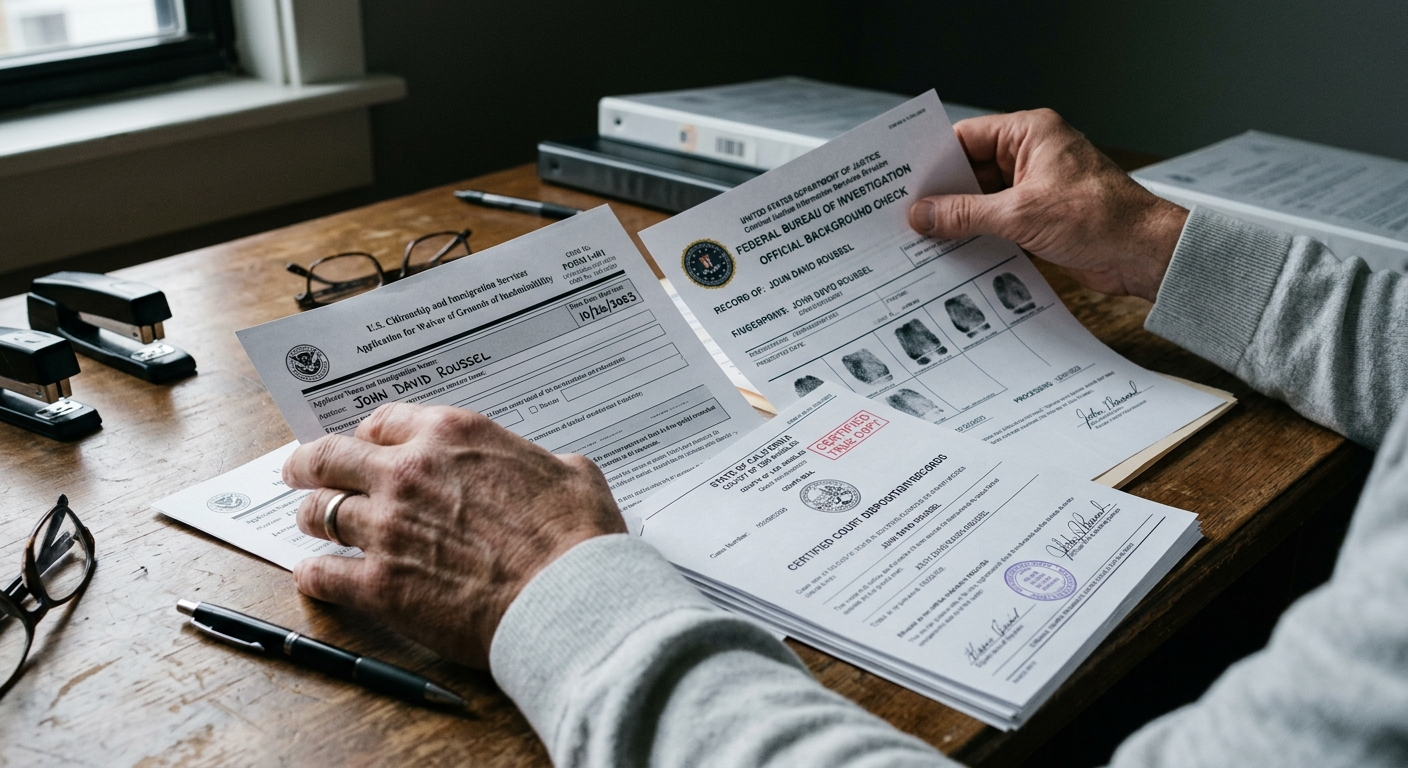
We recommend reviewing your criminal record and obtaining the arrest records and certified court dispositions required for your application. For example, the official I-485 instructions explain the documents needed for arrests, charges, or convictions, including sealed or expunged records and cases with no conviction.
Answer the criminal-history questions on the applicable form truthfully. Fraud or willful misrepresentation of a material fact to obtain an immigration benefit can create a separate ground of inadmissibility. A record review should not be treated as proof of everything the government has on file.
With your record in hand, a legal team can evaluate which grounds apply and whether an exception or waiver may be available. Criminal history isn’t the only ground of inadmissibility: the immigration medical exam covers health-related grounds too.
If you have questions about how a record could affect your immigration case in Austin, Laredo, or anywhere in Texas, contact our immigration attorneys to review your case in detail before you file anything.
Frequently asked questions about crimes and green cards
What is a crime involving moral turpitude (CIMT)?
A CIMT involves reprehensible conduct and a culpable mental state. The elements of the offense matter; not every theft or assault is automatically a CIMT. For visa or green card applicants, one conviction, or a legally valid admission of committing the crime or its essential elements, can establish this ground under INA §212(a)(2)(A)(i)(I), except for a purely political offense.
The “petty offense” exception requires that you committed only one crime, the maximum possible term of imprisonment was no more than one year, and any prison sentence imposed was no more than six months, regardless of suspension or time actually served.
A separate exception requires only one crime, committed before age 18 and more than five years before both the visa or other documentation application and the application for admission. Any confinement imposed for that crime must also have ended more than five years before those applications. The removal rules for people already admitted are different, so your specific record should be reviewed by an attorney.
Does a suspended sentence still count as a serious conviction?
A court-ordered term of imprisonment counts in full for immigration purposes even if its execution was suspended and no jail time was served. A sentence of one year of probation alone is not a one-year prison term. For an aggravated-felony category requiring at least one year of imprisonment, the offense must also meet that category’s other legal elements.
Do I have to disclose a record that was sealed or expunged?
Yes, when the applicable form asks about that history. For example, Form I-485 requires truthful answers and the relevant arrest and court records even when a case was sealed or expunged. Follow its instructions for required documents and any applicable exceptions. Fraud or willful misrepresentation of a material fact to obtain an immigration benefit can create a separate inadmissibility ground; good moral character is a different evaluation, not a general inadmissibility ground.
How do domestic violence convictions affect a green card holder?
Under INA §237(a)(2)(E), a qualifying conviction after admission for domestic violence, stalking, child abuse, child neglect, or child abandonment can make a person deportable. The domestic-violence ground requires a qualifying crime of violence against a person in a relationship protected by the statute; that requirement does not apply identically to all the other listed grounds.
A criminal conviction is not necessarily required for the protection-order ground. The ground can apply when, after admission, a person is subject to a court-issued order intended to prevent violent or threatening acts of domestic violence, and a court finds that the person violated the part protecting against credible threats of violence, repeated harassment, or bodily injury to the people the order protects. Support or child custody orders or provisions are excluded from this definition. Talk to an attorney before traveling abroad or renewing your green card; renewal is not the same as a new admission.
What if I helped a relative enter the U.S. illegally?
Knowingly helping someone enter, or try to enter, the U.S. in violation of the law can establish the alien-smuggling ground under INA §212(a)(6)(E), even for family reasons. The waiver under §212(d)(11) requires that you helped only someone who was your spouse, parent, son, or daughter at the time, and no other person.
The statutory waiver can cover an otherwise-admissible returning LPR who went abroad temporarily and voluntarily, without a removal order, or someone seeking admission or adjustment as an immediate relative or in the first, second, or third family-preference category. The fourth preference, for siblings, is excluded. USCIS instructions also list qualifying visa applicants who are the fiancé(e) of a U.S. citizen, or the fiancé(e)’s child.
The relationship alone does not guarantee a waiver. Approval is discretionary for humanitarian purposes, family unity, or the public interest, and the applicant must meet the applicable eligibility requirements.