8 min read
A marriage green card can allow the foreign spouse of a U.S. citizen or a green card holder to become a lawful permanent resident of the United States, if the applicable requirements are met. How long it takes depends on the petitioner, the route and the agencies handling the case. Check current processing information rather than relying on a general timeline.
Knowing each stage and the forms involved helps you plan around the decisions still pending. A good first step is to review your case with our immigration lawyers to confirm the best path for your situation as a couple.
Family petition and residence application
The process has two main components: the family petition and the application for permanent residence. They are not always filed one after the other; eligible applicants may file them concurrently.
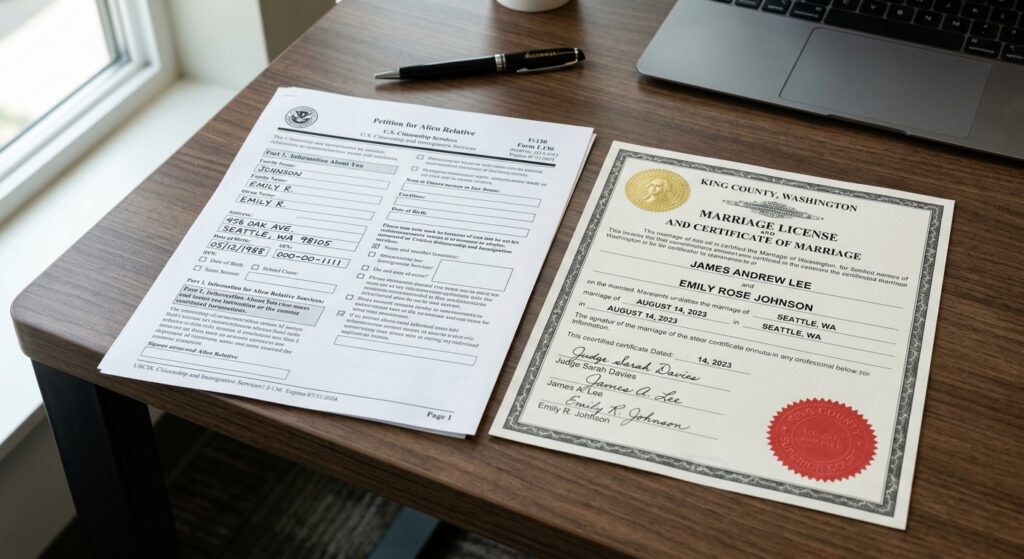
The family petition is Form I-130 (Petition for Alien Relative). USCIS reviews the qualifying marriage and supporting evidence, including whether the marriage was entered into in good faith. Approval of the petition alone does not grant permanent residence.
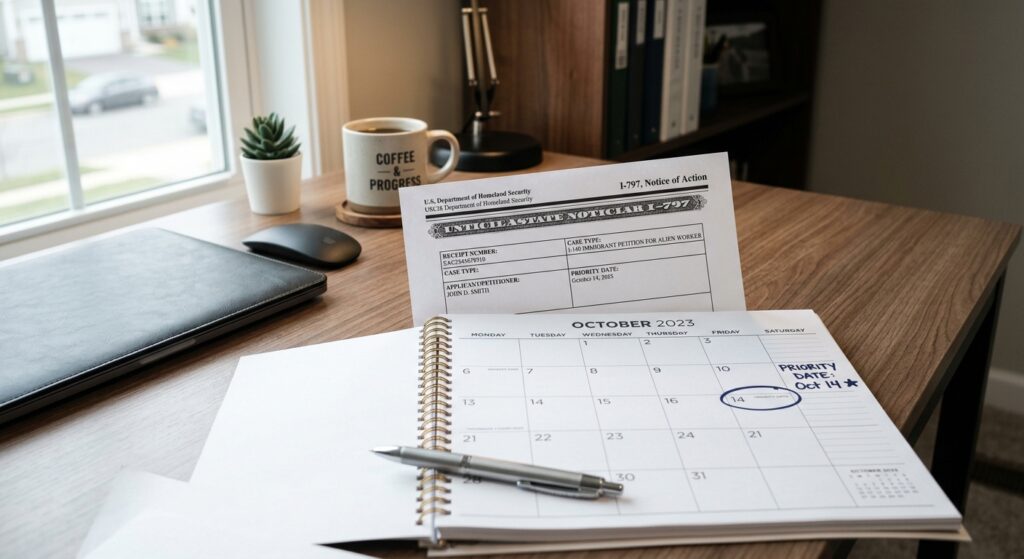
One important difference: a U.S. citizen’s spouse is an immediate relative (IR), without the annual visa-number limit that applies to family preference categories. A green card holder’s spouse is in F2A. For adjustment, check the filing chart USCIS selects each month; being eligible to file does not mean a visa number is available for final approval. For final approval, your priority date must be earlier than the applicable Final Action Date cutoff for your country of chargeability, or the category must be current.
The residence application follows the eligible route: adjustment of status inside the U.S. with Form I-485, or consular processing outside the country. The next steps after I-130 approval differ by route; eligible adjustment applicants do not have to wait for I-130 approval to file I-485.
Does where you live affect how fast the process moves?
Where the foreign spouse lives matters, but location alone does not establish eligibility for adjustment of status. Immigration history, admissibility and the other requirements also determine the available route.
If the foreign spouse is in the U.S., was inspected and admitted or paroled, and meets the other adjustment requirements, including admissibility and a favorable exercise of discretion where applicable, adjustment can lead to residence without consular processing. A U.S. citizen’s spouse may qualify despite an overstay because certain status bars do not apply to immediate relatives; other eligibility and admissibility requirements still apply. Entry without inspection generally prevents adjustment unless an exception applies, such as qualifying under 245(i) or VAWA. Talk to an attorney before filing.
If you are married to a U.S. citizen and eligible for adjustment, you may file I-130 and I-485 concurrently. Form I-864 (Affidavit of Support) is generally required, subject to exceptions. I-765 for a work permit and I-131 for Advance Parole are optional applications, with separate eligibility requirements and decisions. Since April 1, 2024, their fees are generally separate from the I-485 fee, subject to filing-date rules, exemptions and any available fee waiver. Check Form G-1055 for the fees applicable when you file.
If the spouse is outside the U.S., the case generally goes through consular processing. After I-130 approval, the National Visa Center (NVC) collects civil and financial documents and coordinates the embassy or consulate interview when the case is documentarily complete and a visa is available. The Department of State spouse visa guidance explains those steps.
For adjustment, a USCIS-designated civil surgeon completes the required medical examination. Since December 2, 2024, applicants who must submit Form I-693 or a partial I-693 must include it with I-485, following the applicable exceptions and current medical instructions. Consular immigrant visa applicants instead have their examination with an authorized panel physician before the visa interview.
What can affect the review of your case
Two cases that look alike can take different amounts of time. The route, evidence needed and agency workload affect the wait.
A complete, organized package helps address the filing requirements: proof of a good-faith marriage, financial evidence for I-864 when required and the required medical documentation. Including I-693 when required is a filing obligation, not a guarantee of faster approval.
Requests for Evidence (RFEs), form mistakes, inconsistent documents and missed correspondence can add steps or delays. Agency workload and policy changes can also affect processing; a complete file does not guarantee a deadline or approval.
If you spot an error or a gap in your documents, act quickly. To prepare the family petition correctly, review your case with our family immigration lawyers before you file.
Milestones to expect after you file
After USCIS accepts your filing, watch for the notices and decisions relevant to your case. Not every case has the same sequence or schedule.
- Receipt notice (Form I-797C): confirms receipt and provides a receipt number to check your USCIS case status online. It is not an approval or a grant of immigration status. I-797C also serves other notice functions, so read what your notice actually says.
- Biometrics appointment: USCIS schedules fingerprints, a photograph or a signature at an Application Support Center (ASC) if required. Follow the appointment notice; there is no fixed interval after receipt for every case.
- Work permit (EAD) and Advance Parole: if you apply with a pending I-485, USCIS decides each request separately. The I-765 instructions explain work authorization eligibility. Filing does not grant either authorization, and their processing times can differ. Do not begin work based on I-765 until it is approved, unless you already have another valid work authorization.
- Interview: adjustment applicants must be interviewed unless USCIS waives the interview after reviewing the individual record. The officer reviews eligibility, including the marriage evidence. Consular applicants attend a visa interview. It helps to know what happens after the immigration interview.
- Decision: USCIS may approve or deny the adjustment application, or the case may remain pending. A Notice of Intent to Deny (NOID) gives an opportunity to respond before a decision; it is not a final denial. A green card follows approved adjustment or admission as a permanent resident after consular processing, not I-130 approval or visa issuance alone.

How to check official processing times
Processing information changes. For a USCIS case, check the official processing-times tool for your pending forms. Review I-130, I-485 and any optional applications separately rather than treating one figure as the whole process.
For consular processing, also review NVC and embassy or consulate information; an I-485 office estimate does not describe that route. F2A cases additionally depend on visa availability, with filing eligibility and final approval checked separately.
Review the applicable information as your case progresses. Published processing information helps with planning but cannot promise when your individual case will be decided.
Planning your life while you wait
Staying in compliance with immigration rules while you wait is as important as filing the right application. Key points:
- Maintain lawful immigration status when required for your adjustment category. A pending I-485 does not itself grant lawful immigration status, even though some adjustment bars do not apply to immediate relatives.
- If you are a non-U.S. citizen in the U.S. subject to address reporting, notify USCIS within 10 days of moving; A and G visa holders and visa waiver visitors are exempt. Use the applicable USCIS address-change procedure. An online update can satisfy the requirement without paper AR-11; protected VAWA, T, U and I-751 abuse-waiver cases follow special instructions. Updating USPS alone does not update USCIS.
- Document your life together: joint bank account, health insurance, lease, photos, trips and letters.
- Before travel with a pending I-485, check whether you need approved Advance Parole. Departure generally abandons adjustment without it, subject to specific exceptions such as qualifying H or L travel; those exceptions have status, visa and return conditions. Advance Parole does not guarantee entry or erase inadmissibility. Under Matter of Delcarmen-Lara, decided August 13, 2026, an Advance Parole departure counts for the 10-year unlawful-presence ground, prospectively. USCIS also describes departures on or after that date under the 3- and 10-year rules. Whether a bar applies depends on the counted presence, departure, later request for admission and applicable exceptions or relief. Review your history before making travel plans.
If the marriage is less than two years old when adjustment is approved or the spouse is admitted as a permanent resident after consular processing, residence is conditional for two years. It is still permanent resident status.
A joint Form I-751 is generally filed during the 90 days before conditional residence expires. A good-faith marriage ending in final divorce or annulment may support a joint-filing waiver; waiver filing rules differ from the joint window. A petitioning spouse’s death allows an individual filing under its own requirements. Learn more about divorce and your green card.
If you are planning your case or already have one in progress, you can review it with our adjustment of status lawyers or our green card lawyers to line up every step, from the interview to removing conditions.
If you need guidance on your case or want your file reviewed before you send it, schedule a consultation with YSL Immigration Lawyers. We have offices in Austin and Laredo, Texas, and we can help you assess the steps and timing factors for your situation.
Frequently asked questions about the marriage green card
What helps a marriage green card case move faster?
A complete package helps address filing requirements, including evidence of a good-faith marriage and financial support when required. Include I-693 or a partial I-693 with I-485 when required under the current instructions. These steps can prevent missing-evidence problems, but they do not guarantee faster processing or approval.
Can I travel outside the U.S. while my adjustment of status is pending?
Departure generally abandons a pending I-485 without approved Advance Parole, but specific exceptions exist. For qualifying H-1 or L-1 travel, you must be in lawful H-1 or L-1 status, remain eligible, return to the same authorized employer and have the required visa; H-4 or L-2 travel requires lawful status, continued eligibility, a principal maintaining H-1 or L-1 status and the required visa. These exceptions require that you are not in exclusion, deportation or removal proceedings.
Advance Parole does not guarantee entry. Matter of Delcarmen-Lara, decided August 13, 2026, applies its 10-year-bar holding prospectively. USCIS describes Advance Parole departures on or after that date as departures for the 3- and 10-year rules.
More than 180 days but less than one year of counted unlawful presence during a single stay can trigger the 3-year bar after voluntary departure before removal proceedings and a request for admission within three years. One year or more during a single stay can trigger the 10-year bar after departure or removal and a request for admission within ten years. Exceptions and possible relief must also be assessed. Talk to an attorney before making travel plans.
How does a Request for Evidence affect the timeline?
An RFE requests evidence USCIS needs to assess eligibility and can add time to the review. Respond with all requested materials together by the notice’s deadline. A partial response is treated as a request for a decision on the existing record; USCIS does not have to wait for another response. A timely, complete response does not guarantee approval.
Can I skip the in-person interview?
Adjustment applicants must be interviewed unless USCIS waives the interview case by case, considering the relevant evidence. A strong file does not guarantee a waiver. Follow any interview notice you receive; consular immigrant visa applicants follow the embassy or consulate interview process.
What happens if we separate before the green card is approved?
Divorce before approval generally ends the qualifying spousal relationship underlying I-130 and can lead to denial. Separation without divorce does not automatically end the marriage, but USCIS may examine whether it was entered into in good faith. Other options may include a VAWA self-petition if its abuse and eligibility requirements are met.
If a U.S. citizen spouse dies, widow(er) eligibility depends on a valid, good-faith marriage, no divorce or legal separation at death, an approved I-360 (including conversion of a pending or approved I-130, or a self-petition filed within two years of death), admissibility and no remarriage before immigrating, unless eligible under INA 204(l). Death does not automatically grant residence. Talk to an attorney as soon as possible.