
8 min read
Studying for the U.S. citizenship test can be confusing right now: some people are told to study 100 questions, others 128. Both are correct, because USCIS is using two versions of the civics test at the same time. The first step is to find out which version applies to your Form N-400.
In this guide, our team explains how to know which test you will take, how many questions you must answer correctly, what the English portion looks like, and what happens if you don’t pass on the first try.
Which civics test applies to your N-400?
The version of the civics test depends on the date USCIS received your Form N-400, Application for Naturalization:
- If you filed before October 20, 2025, you take the 2008 civics test.
- If you filed on or after October 20, 2025, you take the 2025 civics test.
Your filing date appears on your receipt notice (Form I-797C). USCIS announced the change in the Federal Register in September 2025, and as of late 2026 that cutoff date is still the rule.
| N-400 filing date | Test version and study list | Questions asked and passing score |
|---|---|---|
| Before October 20, 2025 | 2008 test, list of 100 questions | Up to 10 questions; 6 correct to pass |
| October 20, 2025 or later | 2025 test, list of 128 questions | Up to 20 questions; 12 correct to pass |
On the 2025 test, the officer stops asking once you get 12 answers right or 9 answers wrong. Keep in mind that passing the tests does not make you a citizen by itself: USCIS still has to approve your application, and you must take the Oath of Allegiance.

The 2008 civics test: 100 questions by topic
If you filed before October 20, 2025, you study the official list of 100 questions. USCIS groups them into three areas:
- American government: principles of American democracy (questions 1–12), system of government (13–47), and rights and responsibilities (48–57).
- American history: colonial period and independence (58–70), the 1800s (71–77), and recent American history and other important information (78–87).
- Integrated civics: geography (88–95), symbols (96–98), and holidays (99–100).
The civics test is oral, so practice answering out loud, not just reading. Some answers change over time or depend on where you live, such as the names of your U.S. senators, your representative, your state’s governor, the President, or the Speaker of the House. Check those answers at uscis.gov/citizenship/testupdates shortly before your interview.
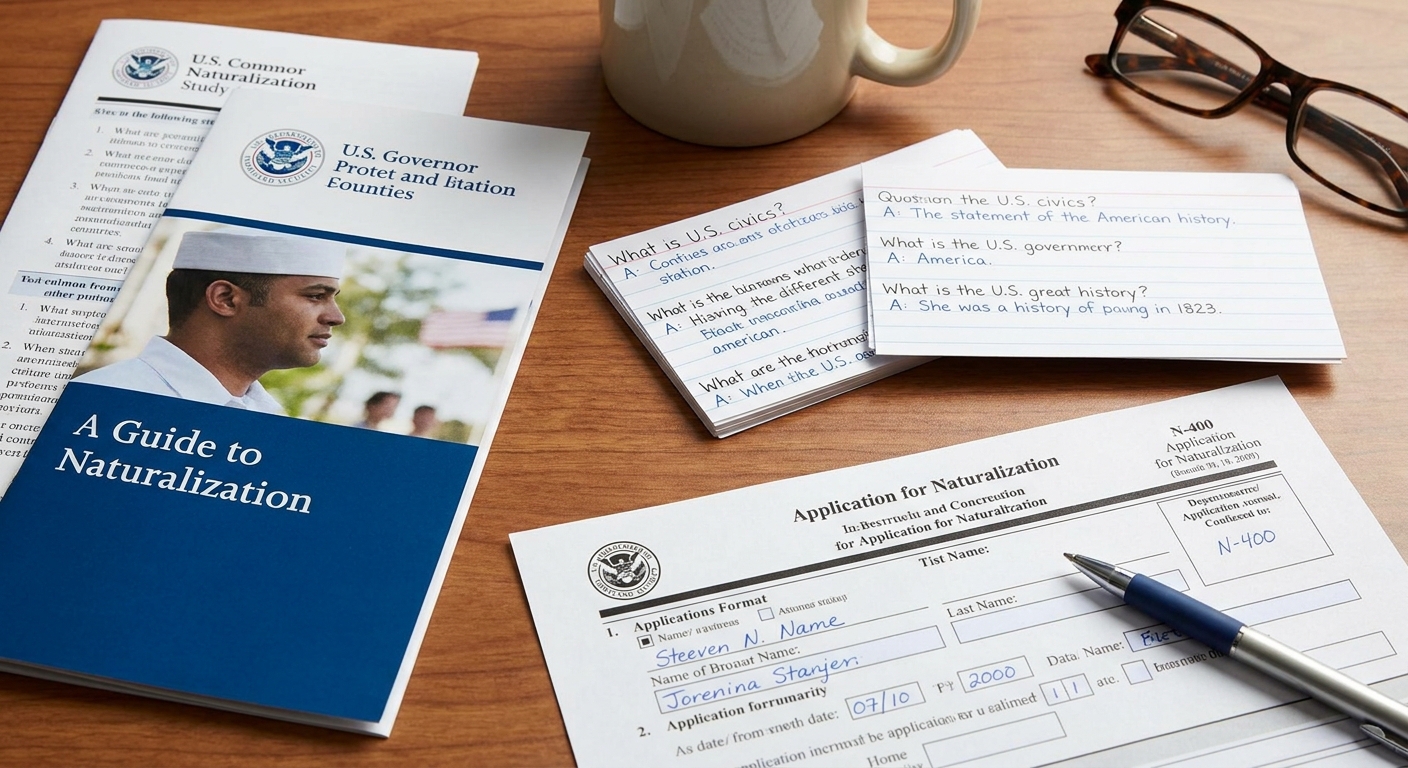
You can download the full list of questions and answers, plus audio files and flash cards, from the official USCIS study page.
What changed with the 2025 test: 128 questions and a new format
The 2025 test uses a longer list of 128 questions. The officer asks up to 20, and you need 12 correct answers to pass. The new list covers the same broad areas (government, history, and civic life), but many questions are worded differently and some ask for more detail.
USCIS publishes all 128 questions in PDF and audio on the same official study page. If you are not sure which list to use, check the date on your N-400 receipt notice before you start studying. Studying the wrong list is one of the most common mistakes we see.
What is the English part of the test like?
The English test has three parts:
- Speaking: the officer evaluates your spoken English during the whole interview, as you answer questions about your application.
- Reading: you must correctly read aloud one of up to three sentences.
- Writing: you must correctly write one of up to three sentences that the officer reads to you.
USCIS publishes reading and writing vocabulary lists on its study page. Practicing with them helps you get used to the words that usually appear.
How to prepare based on your test version
- 2008 test: study the 100 questions. The officer asks up to 10, and you need 6 correct.
- 2025 test: study the official list of 128. The officer asks up to 20, and you need 12 correct.
- 65/20 special consideration: study only the special list of 20 questions that USCIS marks for this group.
- Any version: review answers that change (elected officials) close to your appointment, and listen to the whole question before you answer.
What happens at the citizenship interview besides the test?
The naturalization interview usually has three parts: a review of your N-400, the civics test, and the English test.
The officer will go over your application under oath. Be ready to explain dates, past addresses, trips abroad, marriages, children, and any arrests or citations. If you don’t remember a detail, say so instead of guessing. Bring the documents listed on your interview notice, which may include your green card, a photo ID, passports and travel documents, tax records, or evidence related to your N-400.
At the end, the officer gives you Form N-652, which tells you the result: approved, continued (for example, to retake a test or send more documents), or denied. To know what comes next, read what happens after your immigration interview.
What if you don’t pass part of the test?
You get two chances per application to pass the English and civics tests. If you fail one part, USCIS will schedule a second interview, usually 60 to 90 days after the first one, and you only retake the part you didn’t pass.
If you fail the same part a second time, USCIS can deny your application. You can file a new N-400 later, but you would pay the filing fee again. See our guide on how much it costs to become a U.S. citizen.
English exemptions and special civics considerations
Some older applicants who have been green card holders for many years don’t have to take the English test. Your age and years as a permanent resident are counted on the date you file your N-400.
| Situation | English test | Civics test |
|---|---|---|
| Age 50 or older and a green card holder for 20 years or more (50/20) | Exempt | Required. You can take it in your language with a competent interpreter. |
| Age 55 or older and a green card holder for 15 years or more (55/15) | Exempt | Required. You can take it in your language with a competent interpreter. |
| Age 65 or older and a green card holder for 20 years or more (65/20) | Exempt | Special list of 20 questions; up to 10 asked and 6 correct to pass, in your language. |
| Medical exception with Form N-648 | May be waived | May be waived. USCIS decides if the exception applies. |
If you take the civics test in another language, you must bring an interpreter who is fluent in both English and that language.
Form N-648, Medical Certification for Disability Exceptions, is for people with a physical or developmental disability or a mental impairment that keeps them from meeting the English and/or civics requirement. The condition must have lasted, or be expected to last, at least 12 months, and an authorized medical professional must complete the form. Filing it does not guarantee the exception.
Being married to a U.S. citizen can shorten the time you must wait to apply, but it does not exempt you from the tests. Learn more about marrying a U.S. citizen as an immigrant. If you want help preparing your application and interview, our citizenship and naturalization attorneys in Austin and Laredo, Texas, can guide you.
Frequently asked questions about the U.S. citizenship test
How long does the citizenship interview usually take?
Most naturalization interviews take about 20 to 40 minutes, but it can be longer if your case has complications, such as long trips abroad, arrests, or tax issues. Plan to spend more time at the office, since you may have to wait before you are called.
What documents should I bring to my naturalization interview?
Bring your interview notice, your green card, a government photo ID, your passports and any travel documents, and every document listed on your notice. Depending on your case, that can include tax transcripts, marriage or divorce records, court records, or proof of child support.
How do I know if I take the 2008 or the 2025 test?
Look at the date USCIS received your N-400 on your receipt notice. If it is before October 20, 2025, you take the 2008 test (100 questions). If it is on or after October 20, 2025, you take the 2025 test (128 questions).
If I’m exempt from English, can I use an interpreter for civics?
Yes. If you qualify for the 50/20, 55/15, or 65/20 exemption, you can take the civics test in your language. You must bring your own interpreter who is fluent in English and in your language.
What happens after I pass the interview and the tests?
If USCIS approves your application, you will receive a notice to attend an oath ceremony (sometimes on the same day). You become a U.S. citizen only after you take the Oath of Allegiance and receive your Certificate of Naturalization.
Can USCIS deny citizenship even if I pass the English and civics tests?
Yes. Passing the tests is only one requirement. USCIS also reviews continuous residence, physical presence, good moral character, taxes, criminal history, and whether you were eligible for your green card in the first place. Talk to an attorney before filing if you have any arrests or immigration problems in your past.
What if I’m late to my naturalization interview?
Arrive early. If you are late, the office may not be able to see you and could reschedule your interview, which delays your case. If you know you can’t attend, ask USCIS to reschedule before the appointment. Missing it without notice can lead to your case being closed.