

8 min read
If you’re married to a U.S. citizen, you may be able to get a marriage-based work permit while your green card case is pending. But the work permit doesn’t come automatically with the wedding. You have to request it from USCIS with Form I-765, usually filed together with your green card application (Form I-485).
Filing the right forms, with the right evidence, at the right time makes a big difference. If you want your case reviewed before you file, our work permit attorneys can help you avoid mistakes that cause delays.

What does the Employment Authorization Document (EAD) mean for your case?
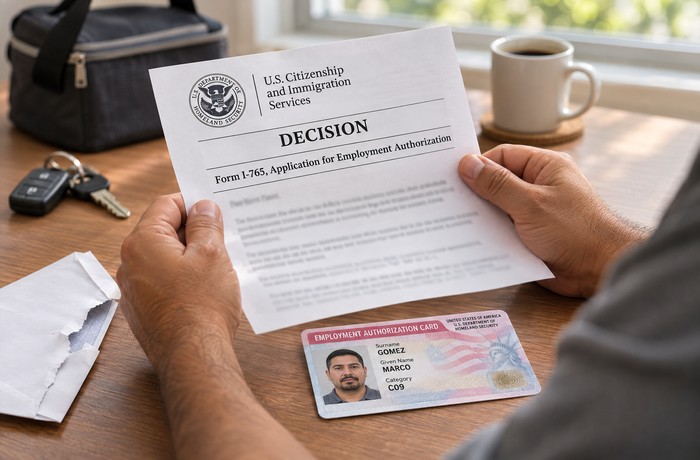
The Employment Authorization Document (EAD) is your official work permit, and you request it with Form I-765. If you’re applying for a marriage green card, the EAD lets you work for almost any employer while you wait for a decision.
A common mistake is thinking the work permit arrives with the marriage certificate. It doesn’t. You have to apply for it.
The most efficient path is usually to file the I-765 together with the I-485 and the I-130 petition. That way, USCIS can process your work permit while your green card case moves forward.
The EAD is temporary. It covers the time your adjustment of status application is pending, and USCIS decides how long each card is valid. In recent years USCIS has shortened the maximum validity for many pending-adjustment work permits, so check the dates on your card and plan your renewal ahead of time.
Once your green card is approved, you no longer need the EAD. As a permanent resident, you can work in the U.S. without a separate work permit.
What are the requirements for a marriage-based work permit?
To qualify, you generally need to be legally married to a U.S. citizen and be in the United States, eligible to adjust your status to permanent resident.
How you entered the country matters. If you were inspected and admitted (or paroled), for example with a visa, you can usually adjust even if your visa expired, because spouses of U.S. citizens are immediate relatives. If you entered without inspection, you generally can’t adjust from inside the U.S. unless an exception applies, such as INA 245(i) or VAWA. Learn more about what happens when you marry a U.S. citizen as an immigrant.
Your U.S. citizen spouse also has to show they can support you financially by filing an Affidavit of Support, Form I-864.
You’ll need documents that prove your identity, your marriage, and your eligibility. Errors or missing documents can lead to delays or even a denial.

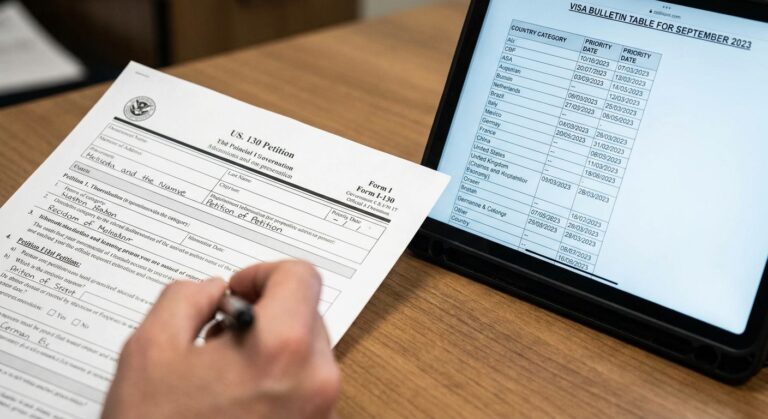
How Forms I-130, I-485, and I-765 work together
These three forms are the core of a marriage-based case filed from inside the U.S. Each one has a different job, and together they let you live and work legally while your case is decided.
Know the purpose of each key form
Form I-130 (Petition for Alien Relative): your U.S. citizen spouse files it to prove your relationship is real. It’s the foundation of the family petition.
Form I-485 (Application to Adjust Status): this is your green card application. It’s how you adjust your status from temporary to permanent resident without leaving the country.
Form I-765 (Application for Employment Authorization): this is the work permit application. It lets you work while your I-485 is pending.
How long does a marriage-based work permit take, and what should you expect?
Processing times change depending on the USCIS office and its workload. A work permit filed with an adjustment of status case can take several months. It also helps to know how much it costs to renew a work permit, since you may need to renew it if your green card case takes a long time.
Check current estimates on the official USCIS processing times page for your form and office, and read our guide on how long a USCIS work permit takes.
Key steps after you file
After you file, USCIS will usually schedule a biometrics appointment to take your fingerprints, photo, and signature for background checks.
You may also get an interview notice. At the interview, you and your spouse will need to show your marriage is real. Learn more about your interview with an immigration officer and what comes next.
What to do if you get a Request for Evidence (RFE)
USCIS sends a Request for Evidence (RFE) when documents are missing or something in your forms needs clarification.
Answering completely and before the deadline helps you avoid delays or a denial.
If you get an RFE or a Notice of Intent to Deny (NOID), get legal guidance right away.
What’s the difference between a work permit (EAD) and Advance Parole?
EAD (Form I-765): lets you work legally and get a Social Security number.
Advance Parole (Form I-131): lets you leave the U.S. and return while your I-485 is pending.
If you travel outside the U.S. without Advance Parole, USCIS will generally treat your green card application as abandoned, and it could be denied. Even with Advance Parole, there’s a new risk: under a Board of Immigration Appeals decision issued on August 13, 2026 (Matter of Delcarmen-Lara), leaving the U.S. on Advance Parole now counts as a departure for the 3- and 10-year unlawful presence bars. If you have more than 180 days of unlawful presence, you could be barred from returning. Talk to an attorney before any trip.

Tips for using your EAD and Advance Parole
You can request both documents along with your I-485. Since April 1, 2024, the I-765 and I-131 each have their own filing fee, even when filed with the I-485. Check Form G-1055 on the USCIS website for current fees before you file.
Don’t start working until you have your EAD in hand, and don’t travel until you’ve received Advance Parole and talked to an attorney about the risks.
If you need to renew your work permit, file early. For most renewals filed on or after October 30, 2025, there’s no automatic extension anymore, so a late renewal could leave you unable to work for a while.
Handling your case carefully can directly shape your future in the U.S. If you want help with your marriage-based work permit or green card, contact YSL Immigration Lawyers at our offices in Austin and Laredo, Texas.
Frequently asked questions about the marriage work permit
What if my visa expired before I applied for a marriage-based work permit?
If you were inspected and admitted when you entered, an overstay usually doesn’t stop the spouse of a U.S. citizen from adjusting status and getting a work permit. If you entered without inspection, it’s more complicated, and you’ll need a detailed legal review to see if an exception applies.
How much does a marriage-based work permit cost?
Since April 1, 2024, Form I-765 has its own fee even when you file it with your I-485, so it’s no longer included in the green card fee. Fees change, so check Form G-1055 on the USCIS website before you file.
Can I get a work permit if my spouse is a green card holder, not a citizen?
Not through this immediate-relative process. Spouses of permanent residents are in a different category (F2A) and usually have to wait until their priority date is current before they can file an I-485. Once you have a pending I-485, you may be able to request a work permit. Talk to an attorney about your timeline.
What happens if my EAD application is denied?
USCIS will send a notice explaining why. Review it with an attorney, who may recommend filing again, a motion to reopen or reconsider, or another path, and who can check whether the denial affects your green card case.
Can I work for any employer with a marriage-based work permit?
Yes. Once it’s approved, a pending-adjustment EAD lets you work for almost any employer, in any industry, while it’s valid.
Can my children get a work permit at the same time because of my marriage to a citizen?
Children aren’t automatically included in your spouse’s I-130 for you. If your child is unmarried, under 21, and qualifies as your citizen spouse’s stepchild (the marriage happened before the child turned 18), your spouse can file a separate I-130 for them. The child can then file their own I-485 and I-765 to get a work permit.