

7 min read
Before you start a VAWA case, you need to know exactly what the law asks for. The VAWA requirements decide who can apply for a green card without the abuser’s help and what evidence USCIS needs to approve the case. Many people search for the “VAWA visa,” but VAWA is not a visa: it is a self-petition (Form I-360) that lets you apply on your own, without your abuser knowing or signing anything.
If you are just learning about VAWA, start with our guide to the I-360 VAWA self-petition. Once you think you may qualify, our team at YSL Immigration Lawyers can review your case and check each requirement with you.
VAWA requirements: who can apply
The Violence Against Women Act (VAWA) lets certain spouses, children and even parents of U.S. citizens or green card holders apply for permanent residence without the abuser taking part. Despite the name, the law protects victims of any gender.
To qualify for a VAWA self-petition, you generally must:
- Have a qualifying relationship with a U.S. citizen or permanent resident: as a spouse, a child, or a parent (parents only if the abuser is a U.S. citizen son or daughter age 21 or older).
- Have suffered battery or extreme cruelty. This includes physical abuse, but also emotional, psychological and financial abuse, threats and control.
- Show good moral character (USCIS usually looks closely at the 3 years before you file).
- Live in the United States, or, if you live abroad, show that the abuse happened in the U.S. or that the abuser is a U.S. government employee or member of the U.S. military.
- Have lived with the abuser at some point. There is no minimum amount of time.
The goal of the law is to protect the victim and stop the abuser from using your immigration status as a tool to control or manipulate you.
Requirements based on your situation
VAWA doesn’t work the same way for everyone. Each type of relationship has its own details that change the evidence you need.
If you are an abused spouse
You must have married a U.S. citizen or permanent resident in good faith, meaning for love and a real life together, not just to get immigration benefits. You also must have lived with your spouse at some point.
If the marriage already ended, you can still file within 2 years after it ended, as long as the divorce was connected to the abuse or your spouse died. You can also apply if your spouse lost their citizenship or green card because of an incident of domestic violence, again within 2 years. Your unmarried children under 21 can usually be included in your petition, even if they were not abused themselves.
If you are an abused child
- You must be unmarried and under 21. You can file up to age 25 if the abuse was at least one central reason you didn’t file earlier.
- The abusive parent must be a U.S. citizen or permanent resident.
- The abuse must have happened while you had a parent-child relationship, including stepchildren in qualifying cases.
If you are an abused parent
- This option only applies when the abuser is your son or daughter who is a U.S. citizen and 21 or older. Parents abused by a green card holder child do not qualify under VAWA.
- You must document the relationship, and the evidence of abuse should be clear and consistent.
Special cases
Abuse is not always physical. VAWA treats psychological abuse, threats, isolation and control just as seriously as physical violence.
VAWA is gender-neutral, so men who are victims of domestic violence can also qualify. If you are not sure whether what you lived through counts as abuse, talk to an immigration attorney before you decide you don’t qualify.
Key evidence and documents
The quality of your evidence decides the case. USCIS looks at your file as a whole, not at one document alone, so it helps to send several pieces of evidence that support the same facts.
- Abuse: your own sworn declaration, statements from witnesses, medical records, psychological or counseling reports, photos, text messages, emails, and letters from shelters or social workers.
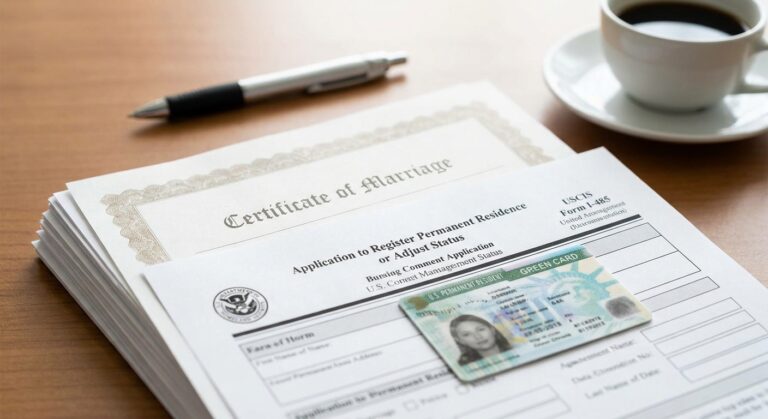
- Qualifying relationship: marriage certificates, birth certificates and family records, plus proof of the abuser’s citizenship or green card.
- Living together: leases, bills at the same address and shared mail.
- Good moral character: police clearance letters or background checks from places you have lived, and your own declaration.
A police report is not required. There are other ways to prove abuse, especially when it was psychological or financial abuse and the police were never involved.
Your case is also confidential. Federal law prohibits USCIS from sharing your VAWA file with the abuser or using information the abuser provides against you, and the abuser is not notified that you filed.
How much it costs to apply
Form I-360 has no filing fee for VAWA self-petitioners. Under the USCIS fee rule in effect since April 1, 2024, VAWA self-petitioners are also exempt from the fee for several related forms, including in most cases Form I-485 (adjustment of status) and Form I-765 (work permit). If a form you need does have a fee and you can’t afford it, you may be able to ask for a fee waiver with Form I-912.
Fees change, so always check the current USCIS fee schedule (Form G-1055) on uscis.gov before you file. Attorney fees depend on the law firm and on how complex your case is.
VAWA processing time
Times vary depending on the USCIS office and how many cases it has. The I-360 decision is usually the longest stage: as of September 2026, USCIS reports that 80% of VAWA I-360 cases are completed within about 52.5 months. Always check the latest numbers at egov.uscis.gov/processing-times.
While you wait, USCIS may issue a prima facie determination, which helps you access certain public benefits. It is not deferred action and does not give you a work permit by itself. Learn more in our guide to the VAWA prima facie determination. If your I-360 is approved, you generally receive deferred action and can get a work permit. See how long a VAWA work permit takes and how long a VAWA green card takes.
How to file a VAWA self-petition, step by step
- Check your eligibility. Review each requirement above with an immigration attorney.
- Prepare Form I-360 with evidence of the abuse, the qualifying relationship, living together and good moral character.
- File for your green card and work permit. If the abuser is a U.S. citizen (you are an “immediate relative”), you can usually file Form I-485 together with the I-360 or while it is pending. If the abuser is a green card holder, you generally file the I-485 once a visa is available for your priority date. After I-360 approval, you can also request a work permit with Form I-765.
Order and consistency in your documents matter at every stage. To see what happens next, read what happens after your I-360 is approved and what VAWA forgives.
Do you think you meet the VAWA requirements? Contact YSL Immigration Lawyers for a confidential consultation at our offices in Austin and Laredo, Texas.
Frequently asked questions about VAWA requirements
Do I have to meet every VAWA requirement?
Yes. USCIS must confirm a qualifying relationship, abuse, having lived with the abuser, residence (or a qualifying connection to the U.S.) and good moral character. If one is missing, your petition may be weakened or denied.
What documents prove the relationship?
Marriage certificates, birth certificates, family records, photos and proof of shared housing, plus proof of the abuser’s U.S. citizenship or green card. Any document in another language needs a certified English translation.
What evidence proves the abuse?
Sworn declarations, medical records, psychological reports, messages, emails, letters from shelters, and community or school reports. A police report is not required, but it can strengthen your case if you have one.
How do I prove we lived together?
With leases, bills, mail, official documents showing the same address, or statements from neighbors and relatives. You only need to show you lived together at some point; there is no minimum time.
What does good moral character mean for VAWA?
USCIS reviews your criminal history and conduct, usually focusing on the 3 years before you file, using official records. Some offenses can be a problem, but in certain cases a conviction connected to the abuse can be excused. Talk to an attorney if you have any arrest or conviction.
What other evidence can help my VAWA case?
Letters from social workers, therapy reports, hospital records, community documents, and proof of long-term residence or financial dependence on the abuser. What matters most is that dates, statements and documents are consistent with each other.
Is there such a thing as a VAWA visa?
Not exactly. “VAWA visa” is a common way to describe the VAWA self-petition (Form I-360). If it is approved, it can lead to a green card through adjustment of status. For victims of certain crimes who help law enforcement, a related option is the U visa.