7 min read
Knowing what happens after I-360 approval under VAWA is the question almost everyone asks right away. The approval means USCIS recognizes that you meet the requirements for protection without depending on your abuser. But it is not the end of the road yet.
It is the first milestone in a process with several steps, deadlines, and decisions that depend on your situation. At YSL Immigration Lawyers we guide you through every stage, and our VAWA attorneys can review your case to define the best path for you.
What does it really mean that your I-360 was approved?
Your approval is confirmed with an approval notice on Form I-797, Notice of Action. It is the official proof that USCIS approved your VAWA self-petition and that you qualify for the protection of the law. With that document, your immigration situation starts moving in a new direction.
With the approval, USCIS generally also grants you deferred action. That means USCIS decides not to prioritize your removal for a period of time, and it allows you to apply for a work permit based on that deferred action.
Before the approval, many people receive a VAWA prima facie determination (Notice of Prima Facie Case). It is a preliminary finding that your petition meets the basic requirements. It is used to access certain public benefits, and it stays valid until your I-360 is approved or denied. It is not deferred action and it is not a work permit.
The key point here: I-360 approval does not give you a green card by itself. What it does is open the door to the next steps, such as applying for a green card through adjustment of status or consular processing, getting a work permit (EAD), and, when it applies, accessing certain public benefits.
Once you have your approval notice, check your USCIS case status often so you can spot updates, Requests for Evidence (RFEs), or scheduled appointments.
If your I-360 was denied instead of approved, you still have options. You can review the specific reasons for the denial, consider an appeal or a motion to reopen or reconsider (Form I-290B), or prepare a new petition with stronger evidence. These steps need careful legal analysis, and the deadlines are short.
Can you apply for a green card right away, or do you have to wait?
Once you are approved, the first big decision is when and how to apply for your green card. The answer depends on your VAWA category, so review it carefully before you file anything.
If you are the spouse or child of a U.S. citizen, or the parent of a U.S. citizen son or daughter who is 21 or older (the abuser must be that son or daughter), you are considered an immediate relative. You can file Form I-485 (adjustment of status) without waiting for a priority date to become current.
If you are the spouse or child of a green card holder (permanent resident), your case depends on the Visa Bulletin. These categories have priority dates and annual limits, which can mean months or years of extra waiting before you can file the I-485.
One option that saves time, when it is available, is filing the I-360 and the I-485 together (concurrent filing) instead of waiting for the approval. This is generally possible for immediate relatives, or when your priority date is already current. Your legal team can tell you whether it fits your case.
This process is different from an approved I-130 family petition, where a sponsor files on behalf of the beneficiary. With VAWA, you are in control and do not depend on the abuser.
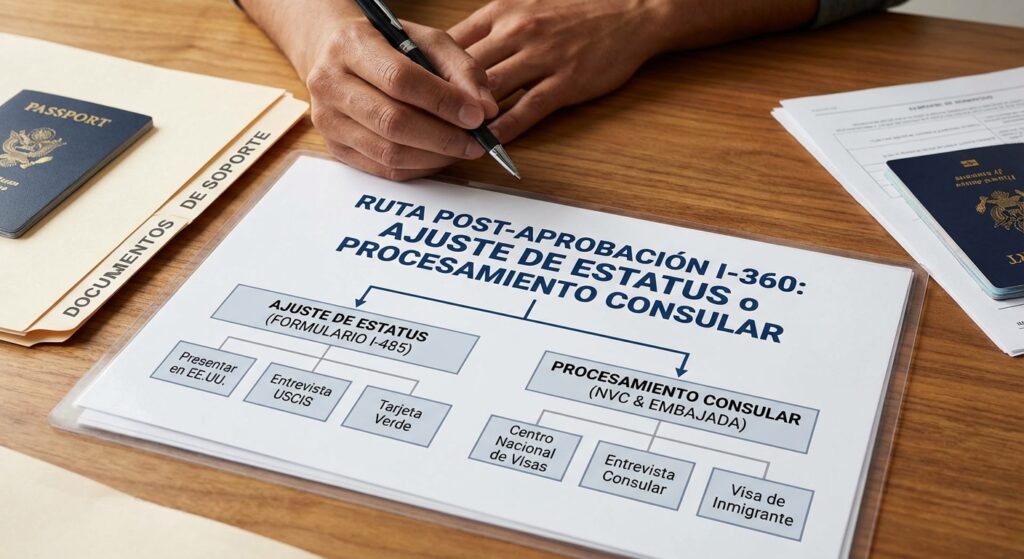
If you are inside the U.S.: how to move toward your green card
If you live in the United States, the usual path is adjustment of status with Form I-485 based on your VAWA approval. It lets you get permanent residence without leaving the country and without going to a consulate. VAWA self-petitioners can often adjust even if they entered without inspection, which is an important difference from many other family cases.
The documents you will typically need are the completed I-485, evidence related to admissibility, the medical exam (Form I-693, which USCIS generally requires you to submit with the I-485), identity documents, recent photos, and proof of your approved I-360.
The process usually includes a biometrics appointment, sometimes an interview, and, depending on the case, a Request for Evidence. Keep your documents organized and answer every request on time to avoid delays.
While you wait, you can apply for a work permit with Form I-765. To see how long it can take, read about VAWA work permit processing time and USCIS work permit processing times. Since April 1, 2024, an I-765 or I-131 filed with an I-485 has its own fee, so check Form G-1055 for current fees before you file.
You may also be thinking about travel with Advance Parole (Form I-131). Be very careful: under a Board of Immigration Appeals decision issued on August 13, 2026 (Matter of Delcarmen-Lara), leaving the U.S. on Advance Parole now counts as a departure for the 3- and 10-year unlawful presence bars. If you have more than 180 days of unlawful presence, you could be barred from returning. Talk to an attorney before you travel.
If you are outside the U.S.: how consular processing works
If you do not live in the United States, the path changes. USCIS sends your approved case to the National Visa Center (NVC), which then coordinates your interview at the U.S. consulate or embassy in your country. This is called consular processing.
You will need to gather civil documents (birth certificate, marriage certificate, divorce decree if it applies), police certificates, a medical exam by a doctor approved by the consulate, photos that meet the requirements, and your full VAWA evidence package.
The consular interview is the decisive step. The officer reviews your file, verifies your identity, and evaluates whether you are admissible. Careful preparation with legal help makes a big difference in the outcome.
If you are still not sure what VAWA covers and who it protects, read about what VAWA forgives before your interview so you arrive with all your answers ready.
What can delay or complicate your green card after I-360 approval?
Whichever path you take, adjustment of status or consular processing, some common issues can make each stage take longer. Knowing them ahead of time helps you avoid surprises.
- Requests for Evidence (RFE): USCIS may ask for more documents to confirm eligibility or admissibility, which pauses your case until you respond.
- Inadmissibility issues: criminal history, past immigration violations, or health issues may require a specific immigration waiver before your case can move forward.
- Backlogged priority dates: for categories that depend on the Visa Bulletin, retrogression can delay filing the I-485 by months.
- Mistakes in your documents: forms filled out incorrectly, dates or names that do not match, or not enough evidence.
- Medical exam problems: the I-693 must be signed by a USCIS civil surgeon, submitted in a sealed envelope, and filed correctly.
- Address changes you did not report: USCIS requires you to update your address with Form AR-11 within 10 days of moving.
- Office delays: local workloads and differences between USCIS offices affect processing times, and you cannot control them.
Every case after approval has its own details. Your category, where you are, your immigration history, and the documents you have all change the path. At YSL Immigration Lawyers we prepare the next form with you, organize your evidence, and answer any RFE to reduce risks. If you want a detailed review of your situation, our VAWA attorneys can do it with you.
How long does the green card take after I-360 approval?
Once your path is clear and you know the risk factors, the question is time. The total wait depends on the USCIS office, your category, and how complex your case is.
If you file the I-485 from inside the U.S., the green card can still take many months after the I-360 approval. Check the current USCIS processing times for your office. For consular processing, timing depends on the National Visa Center and on appointment availability at each consulate.
Keep in mind that the I-360 itself takes a long time: as of September 2026, USCIS completes 80% of VAWA I-360 cases within about 52.5 months. If you need extra documents to prove the VAWA requirements, the process gets longer. For a full estimate from filing to green card, read how long a VAWA green card takes.
After your I-360 is approved comes a decisive stage: filing the next form correctly, gathering the right documents, and keeping your case moving without mistakes that can cost you months. At YSL Immigration Lawyers, with offices in Austin and Laredo, Texas, we walk with you through every step. If you need clarity about what applies to your situation, contact us and we can review it together.
Frequently asked questions about what happens after I-360 approval
What are my options for getting a green card after my VAWA I-360 is approved?
There are two main options: adjusting status from inside the United States by filing Form I-485, or consular processing if you are currently outside the country. The choice depends mainly on where you are and your eligibility. Either way, preparing your documents, records, and medical exam is key. Talk to an attorney to review your case.
How do I choose between adjustment of status and consular processing after I-360 approval?
It depends mostly on whether you are inside or outside the U.S. Unlike many other family cases, VAWA self-petitioners can often adjust status inside the U.S. even if they entered without inspection. Consular processing is handled from abroad. Visa availability and possible inadmissibility issues also matter. An attorney can compare both options for your situation.
What documents do I need to adjust status in the U.S. after I-360 approval?
You usually file the I-485 with your I-360 approval notice, identity documents, photos, criminal and court records if they apply, and the medical exam (Form I-693). You do not need to prove current lawful status to adjust through VAWA. You can also ask for a work permit (EAD) and, if needed, Advance Parole, but talk to an attorney before traveling. Keeping your information updated and consistent helps avoid delays.
What documents do I need for consular processing if I am outside the U.S.?
You usually need your I-360 approval notice, a valid passport, police certificates, medical exam results, and proof of eligibility. Birth and marriage certificates are also common. The process includes an immigrant visa review and an interview at the U.S. embassy or consulate, followed by the visa that lets you travel and become a permanent resident when you enter.
What should I watch for to avoid mistakes that could delay my case?
Delays often come from incomplete documents, inconsistent records, or changes in your situation. To avoid them, check every document before you file, keep clear records of dates and names, report address changes, and answer USCIS requests on time. Ask an attorney if you have specific doubts.
What steps can I expect after I file my green card application?
You can expect receipt notices (Form I-797C), a biometrics appointment, and possibly a Request for Evidence or an interview. Then comes the decision on your I-485 or immigrant visa, and finally your green card. Staying in touch with your attorney helps you adjust the plan if your circumstances change.