
6 min read
Yes, it’s possible to get a U.S. visa even if you were in the country without status, but not just any visa, and not without planning. The answer depends on how long you were unlawfully present, whether you left the country, and what family ties you have with U.S. citizens or permanent residents.
Understanding how the unlawful presence bars work and which waivers exist is key before you pay any consular fees. The right path varies a lot from case to case, so it’s worth reviewing yours with our legal team before taking any step.
What counts as “unlawful presence” in immigration law?
Immigration law uses a technical term: unlawful presence. It generally means being in the U.S. after the authorized period of stay expires or without admission or parole. For many visa entrants, the I-94 records that authorized period; the visa expiration date or loss of status alone does not establish the exact period of unlawful presence.
For the 3- and 10-year bars under INA §212(a)(9)(B), time before age 18 and time while a bona fide asylum application is pending generally do not count. The asylum exception does not apply if you worked without authorization while the application was pending. Other exceptions have specific conditions and should not be assumed to apply to the permanent bar.
The 3- and 10-year bars
The 3- and 10-year bars under INA §212(a)(9) depend on the amount of unlawful presence, departure or removal, and when you seek admission again. They are separate from the permanent bar below.
- 3-year bar: more than 180 days but less than one year of unlawful presence during a single stay, followed by a voluntary departure before proceedings under INA §235(b)(1) or §240 begin, and a new request for admission within three years of that departure.
- 10-year bar: one year or more of unlawful presence during a single stay, followed by departure or removal, and a new request for admission within ten years of that departure or removal.
- Permanent bar (INA §212(a)(9)(C)): can apply after more than one year of unlawful presence in the aggregate, or a removal order, followed by entering or attempting to reenter without admission.
The general exception to the permanent bar requires seeking admission more than ten years after your last departure, at least ten years physically outside the U.S., and DHS consent before reembarking or attempting readmission. Filing Form I-212 is not the same as obtaining that consent.
A VAWA self-petitioner may have a separate waiver under §212(a)(9)(C)(iii) if there is a connection between the abuse and removal, departure, reentry or attempted reentry. Being a victim alone is not enough.
If an inadmissibility ground applies, filing a waiver request does not remove it. The required waiver must be available and granted, and you must still qualify for the visa.
For eligible immigrant visa applicants expecting inadmissibility only under §212(a)(9)(B), Form I-601A provides a provisional waiver process before departure. It does not cover the permanent bar or every other ground.
Waivers that can open the door
There are several waivers, each with its own requirements. USCIS keeps the current Form I-601A rules on its official Form I-601A page:
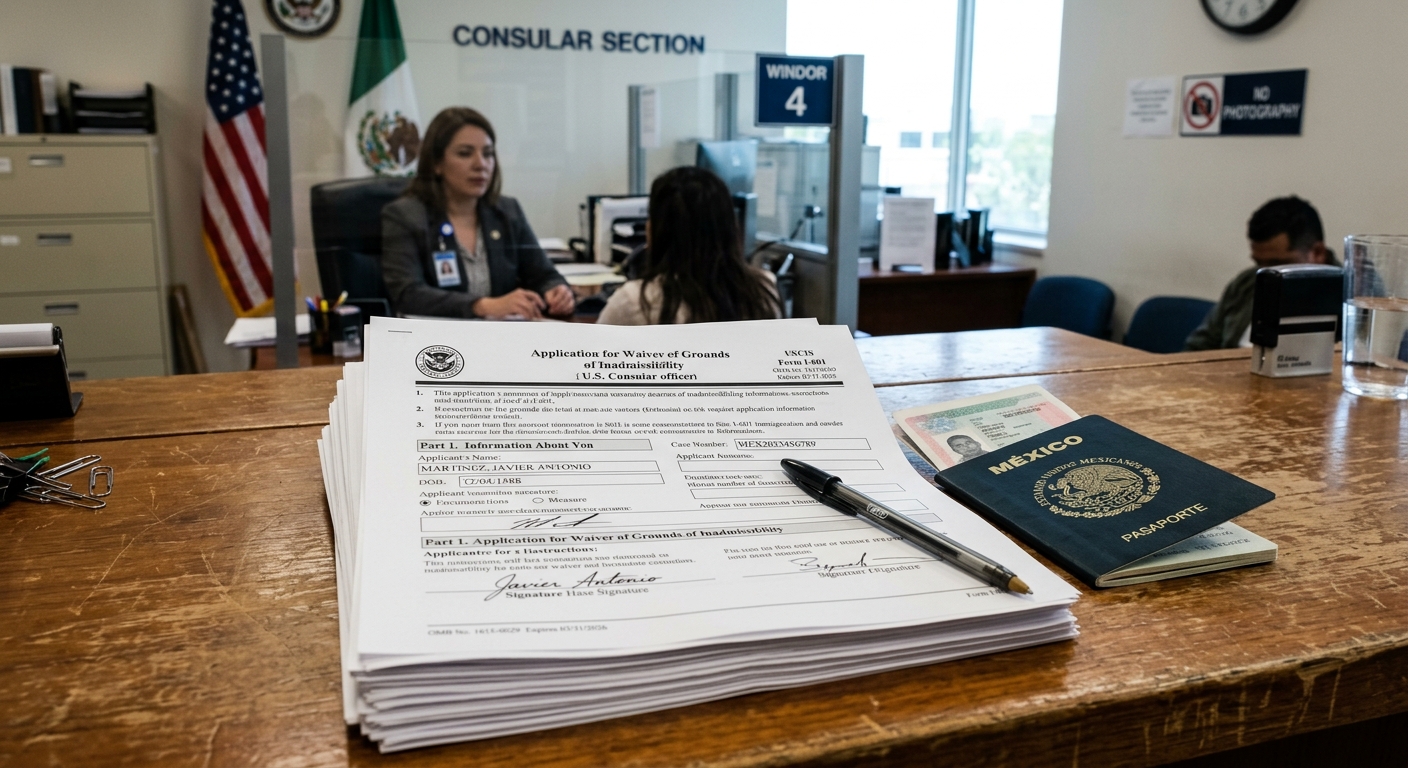
- Form I-601A (provisional waiver): lets eligible applicants request a §212(a)(9)(B) waiver from inside the U.S. before the immigrant visa interview abroad. It requires extreme hardship to a U.S. citizen or lawful permanent resident spouse or parent and a favorable exercise of discretion.
- Form I-601 (general waiver): an I-601 waiver may be available for unlawful presence, fraud or certain criminal grounds, depending on the rules for each ground. In consular cases, it is filed after the officer identifies the inadmissibility ground.
- Form I-212 (permission to reapply): may be needed when consent to reapply is required under a removal-related ground or the permanent-bar exception. An additional I-601 is needed only if another ground requires an available waiver.
To file I-601A, you must be physically in the U.S., at least 17 at filing and expect inadmissibility only under §212(a)(9)(B). You also need an eligible immigrant visa case pending with DOS, as a principal applicant or eligible spouse or child derivative.
That DOS case must be based on a qualifying approved petition, with the required immigrant visa processing fee paid, or selection under the Diversity Visa program. The qualifying relative for hardship can differ from the relative who filed the immigrant petition.
I-601A is not available with a pending I-485, a final decision reinstating a prior removal order, or an unexpired grant of voluntary departure. If you are in removal proceedings, they must be administratively closed and not back on the EOIR calendar when you file.
With an administratively final removal, exclusion or deportation order, USCIS must already have granted consent to reapply under §212(a)(9)(A)(iii) through Form I-212 before you file I-601A. The other I-601A requirements still apply.
I-601A approval does not grant immigration status or work authorization, protect you from removal, or stop unlawful presence from accruing. It does not guarantee a visa or admission.
The waiver takes effect only after departure, the immigrant visa interview and the consular determination that you are otherwise admissible and eligible for the visa. If you are in removal proceedings, resolve them before departure as required by the instructions; approval alone is not a reason to travel.
Removal-related bars under §212(a)(9)(A) can be five years for specified arriving-alien removals, ten years for other removals, twenty years after a second or subsequent removal, or have no time limit for a person convicted of an aggravated felony. Whether consent to reapply is required depends on the ground and whether its period has ended.
Knowing the types of immigration waivers helps you identify the right requirements, especially when a green card case is already underway.
Tourist visa vs. immigrant visa: how the picture changes
For someone with a history of unlawful presence, the difference between applying for a tourist visa and an immigrant visa is huge.
A tourist visa (B-1/B-2) requires eligibility for a temporary visit and overcoming the presumption of immigrant intent under INA §214(b). Officers assess your individual circumstances, including travel plans, finances and ties outside the U.S. A history of unlawful presence also requires a separate inadmissibility review.
An immigrant visa follows a different path. Family- and employment-based categories generally rely on an approved petition; Diversity Visas have different rules. A waiver may be available on an eligible immigrant visa path, but the grounds, qualifying-relative requirements and procedure must be checked separately.
Special paths for victims and people at risk
Some paths have their own rules that can overcome inadmissibility for unlawful presence:
- U visa: for victims of qualifying crimes that violated U.S. law or occurred in the U.S. or its territories, with substantial physical or mental abuse and the required information and helpfulness. A DHS waiver under §212(d)(14) is discretionary in the public or national interest and excludes §212(a)(3)(E).
- T visa: requires severe trafficking, physical presence in the U.S., American Samoa or the Northern Mariana Islands (or their ports of entry) on account of that trafficking, required assistance to law enforcement or an applicable exception, and extreme hardship involving unusual and severe harm upon removal. A DHS waiver under §212(d)(13) is discretionary in the national interest, has exclusions and requires a victimization connection for covered grounds other than health grounds.
- VAWA: for qualifying abused spouses or children of U.S. citizens or lawful permanent residents, and qualifying abused parents of U.S. citizens aged 21 or older. Relationship, shared residence, abuse and good moral character rules apply where required. Filing a self-petition does not itself grant status. Our VAWA attorneys can review eligibility.
- Asylum: after asylum is granted, adjustment under §209(b) has separate requirements, including one year of physical presence after the grant, continued qualification as a refugee or a qualifying spouse or child of a refugee, no firm resettlement and admissibility. Under §209(c), DHS or the Attorney General may waive certain grounds for humanitarian purposes, family unity or the public interest; designated criminal and security-related grounds are excluded.
These paths don’t apply to everyone, but they completely change the picture for people whose cases fit.
What the consular officer looks at
At the consulate, DOS determines visa eligibility and applicable inadmissibility grounds. USCIS adjudicates I-601 and I-601A requests, including extreme hardship where required. Your file must address the relevant requirements at each stage:
- How truthful and consistent your full immigration history is.
- USCIS’s waiver determination and the hardship requirement for that particular waiver.
- Departure, entry and removal dates, to identify which statutory periods apply.
- Your criminal and immigration record, including any prior orders.
- Family relationships, if required by the visa category or the applicable waiver.
Fraud or a willful misrepresentation of a material fact to obtain a visa, admission or another immigration benefit can cause permanent inadmissibility under INA §212(a)(6)(C)(i). Not every omission meets that standard; waiver availability must be reviewed separately.
A criminal record doesn’t always close the door, but it’s important to first understand which crimes can block an immigration benefit before giving up on your case.
Recommended steps before starting the consular process
Before requesting a consular appointment or sending any form, organize your case carefully:
- Request relevant immigration records through FOIA from the agencies that may hold them. Responses cover records found and available for release, with exemptions, exclusions and other limitations; they do not guarantee a complete immigration history.
- Calculate your actual unlawful presence, accounting for exceptions and exact dates.
- For a §212(a)(9)(B) waiver, review extreme hardship to a U.S. citizen or lawful permanent resident spouse or parent. Other waivers requested on I-601 can have different qualifying relatives or alternatives, depending on the ground.
- Check whether a special path applies, such as U, T or VAWA, before ruling it out.
- Build strong evidence of extreme hardship: medical, psychological, financial, and community-related.
If you are already pursuing a family-based immigration case, our adjustment of status attorneys can review whether a waiver is available for your particular process. I-601A is for an eligible consular case, and cannot be filed while an I-485 adjustment application is pending.
If you have specific questions about your case, schedule a consultation with our legal team to review timelines, possible waivers, and the right order of filings before taking the first step.
Frequently asked questions about unlawful presence waivers
Can I get a tourist visa if I was in the U.S. without status?
It depends on your individual eligibility. A B-1/B-2 applicant must qualify for a temporary visit and overcome INA §214(b), while any unlawful presence ground is reviewed separately. An immigrant visa is an option only if you qualify for that category and any required waiver.
Who exactly is a “qualifying relative” for the I-601A waiver?
A qualifying relative is a U.S. citizen or lawful permanent resident spouse or parent. For the I-601A (unlawful presence), U.S. citizen children do not count as qualifying relatives. Checking this before you file helps you avoid costly denials.
Can I start the process inside the U.S. without going to a consulate?
Adjustment of status under INA §245(a) generally requires inspection and admission or parole, or an approved VAWA self-petition, plus visa availability, admissibility and the other requirements. The bars and exceptions in §245(c) also matter. Some people who entered without inspection may qualify under §245(i), which has its own requirements.
Others may need consular processing, but I-601A eligibility must be assessed separately. I-601A is not available while an I-485 is pending. The right path depends on your specific immigration history.
What if I was deported before?
A prior removal may create a bar under §212(a)(9)(A): five, ten or twenty years, or no time limit for a person convicted of an aggravated felony, depending on the history. I-212 may be needed if consent to reapply is still required; it is not automatic for every past removal.
The permanent bar under §212(a)(9)(C) has a different rule: its general exception requires more than ten years since the last departure, at least ten years physically outside the U.S., and DHS consent before reembarking or attempting readmission. An I-601 is needed only if another ground requires an available waiver.
How long does the I-601A waiver take?
Processing times vary. Check the current USCIS processing times for Form I-601A before planning travel or a consular appointment. The published estimate does not guarantee when USCIS will decide your case, and I-601A approval does not guarantee a visa or admission.