
Once you file the immigration papers, all you have to do is wait. And occasionally this waiting process feels too long,especially in the case of a family-based green card. So, how long does a family-based green card take?
The honest answer is that for many immediate relatives, it takes about a year or more, while for some preference categories, it can take much longer. It basically depends on who sponsors you and where you were born. Some family preference categories can take up to 20 years or more, but that is the extreme, not the norm. For immediate relatives of U.S. citizens, the process can move much faster when the case is filed correctly from the start. Even when a family petition looks like simple paperwork, every error, omission, or Request for Evidence adds unnecessary delays. And every month of delay has a real cost: a higher risk of detention while the relative remains without status, and changes in circumstances (age, marital status, employment, or the law itself) that can affect eligibility. Working with an attorney from the beginning helps avoid those delays and prevents mistakes that, once filed with immigration, are difficult to fix.
In this blog, we will provide you with a complete breakdown of each part of a family-based green card case in simple words.
The Short Answer: Family-Based Green Card Processing Time
There are two things that determine your wait:
- First, your relationship to the person who sponsors you.
- Second, whether a visa is available to you immediately.
Immediate relatives move fastest. An immediate relative is the spouse, parent, or unmarried child under 21 of a U.S. citizen. These relatives never have to wait in a visa line.
Relatives apart from the immediate relative fall into “preference” categories. The law caps these visas each year. As a result, a line forms.
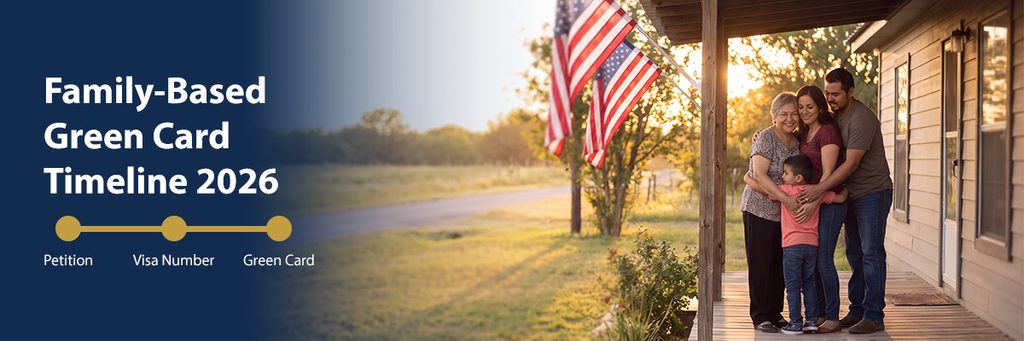
The Family-Based Green Card Timeline, Step by Step
Every green card case follows the same basic steps, but each step takes its own time
Step 1: File the Petition
First, the one who is a U.S. citizen or green card holder files the I-130 petition for an alien relative with USCIS. This form proves the family relationship is real.
How Long Does an I-130 Take for a Family Member?
For immediate relatives, USCIS took about 12.9 months in fiscal year 2026 (through May), based on its historic processing data. On the other hand, preference cases often take longer. Times also change by office. So, make sure to check the USCIS processing times tool for your exact case.
Step 2: Wait for a Visa Number
The second step consists of waiting for a Visa number. Preference relatives must wait until their “priority date” becomes current. Your priority date is the day USCIS received your I-130 petition. The State Department posts the line’s progress each month in the Visa Bulletin. Meanwhile, immediate relatives skip this step entirely.
Step 3: Pick Your Path
In the last step, the case splits in two. This is the choice between adjustment of status and consular processing:
- Adjustment of status: If you live in the U.S. and qualify, you file the I-485 application to adjust status. You stay here while USCIS decides.
- Consular processing: If you live abroad, your case moves to the National Visa Center (NVC). Then you attend a U.S. embassy or consulate interview in your home country.
If you entered without inspection: People who entered the U.S. without inspection generally cannot adjust status inside the country. There are limited exceptions, such as certain people covered by Section 245(i) and VAWA self-petitioners. For most, the path runs through consular processing abroad. However, leaving the U.S. can trigger a 3-year or 10-year bar to return, depending on how long you stayed without status. Some relatives may qualify for a provisional unlawful presence waiver (Form I-601A) before they leave. Learn more in our guides to the I-601 waiver and getting a visa after unlawful presence.
Family Green Card Wait Time by Category
The November 2026 Visa Bulletin shows which priority dates can move forward now. Most countries share one set of dates, but Mexico has its own, longer dates. The table below shows the Final Action Dates, which decide when a green card can actually be issued.
| Case | Final Action Date: most countries | Final Action Date: Mexico |
| F1 (unmarried sons and daughters, 21+, of U.S. citizens) | January 22, 2021 | September 22, 2008 |
| F2A (spouses and children under 21 of green card holders) | October 22, 2026 | April 22, 2026 |
| F2B (unmarried sons and daughters, 21+, of green card holders) | August 22, 2020 | May 15, 2010 |
| F3 (married sons and daughters of U.S. citizens) | October 22, 2015 | July 15, 2001 |
| F4 (brothers and sisters of U.S. citizens) | October 22, 2012 | April 22, 2001 |
In simple terms, if your priority date falls before the listed date, your case can move ahead. The bulletin also has a separate Dates for Filing chart, which shows when you can submit some paperwork early. For F2A, that chart is “Current”in November 2026. F2A Dates for Filing are still Current. But keep in mind that these dates change every month.
Why Your Family-Based Immigration Wait Time Can Grow
There are several things that can slow down a case process. It includes:
- Country of birth: Per-country limits create longer lines for Mexico, the Philippines, and India in some categories.
- Missing documents: A Request for Evidence (RFE) can add months.
- Life changes: A child who turns 21 or marries may switch categories. However, the Child Status Protection Act (CSPA) may protect some children from “aging out,” so check with an attorney before assuming a child has switched categories.
- Sponsor changes: On the other hand, if a green card holder becomes a citizen, a relative may move into a faster category.
Sponsoring Parents and Siblings
How Long Does It Take to Sponsor a Parent for a Green Card?
Well, here’s the good news. Parents of U.S. citizens count as immediate relatives. So, they face no visa line. You must be at least 21 to file. As a result, the main wait comes from USCIS and consular processing, not from a backlog.
How Long Does It Take to Sponsor a Sibling for a Green Card?
On the other hand, siblings face the longest wait. They fall under F4. Currently, most countries are processing cases that were filed in late 2012, which is approximately 14 years ago. For Mexico, the line reached April 2001, about 25 years ago. You must be a U.S. citizen age 21 or older to file.
Conclusion
Your wait depends on your relationship, your category, and your country of birth. For many immediate relatives, it takes about a year, while waits of 20+ years are the exception, not the rule.
However, waiting or filing alone carries real risk. A missing document, a Request for Evidence, a child turning 21, or a trip abroad at the wrong time may add years to your case or even close a door.
Do you have questions about your family case? Attorney Yohana Saucedo and our team serve families from offices in Austin and Laredo, Texas, in both English and Spanish. Schedule a consultation today so we can review your case before small mistakes become long delays.
How Long Does It Take to Get a Green Card Through Family?
Immediate relatives usually wait a year or more, mostly for paperwork.
Preference relatives can wait a few years to more than two decades.
Can I work while my case is pending?
Yes, often you can still work. If you file an I-485 inside the U.S., you can apply for a work permit at the same time.